Dr. Pramod Kumar Pandey — Pharmaceutical Trainer, Founder of PharmaGuru, Blogger & Analytical Expert with 31+ years of experience in leading global and Indian pharmaceutical companies.
A chromatogram is interpreted by analysing the axes, identifying the peaks, and evaluating their characteristics such as Retention Time, Peak Shape, Peak Height and Area.
How to Read A Chromatogram In HPLC and GC: Peak, RT (Retention Time) and RRT
How to Read a Chromatogram is one of the fundamental skills to proceed with the HPLC and GC analysis. A chromatogram is interpreted by analysing the axes, identifying the peaks, and evaluating their characteristics such as Retention Time, Peak Shape, Peak Height and Area.
In this article, I will explain how to read and interpret chromatograms, focusing on key elements like retention time, peak area, resolution, and common troubleshooting tips. By the end, you will be equipped to confidently answer key questions such as:
What is a chromatogram, and how do you read it?
What is a peak in chromatography?
What is retention time, and how is it determined?
What is relative retention time, and why is it important?
What is the capacity factor, and how is it calculated?
How to Read A Chromatogram?
Chromatograms are interpreted by analysing the axes, identifying the peaks, and evaluating their characteristics. This helps in both identifying and quantifying the components in a sample.
Axes of a Chromatogram
X-Axis (Retention Time): This represents the time (usually in minutes) between sample injection and the detection of each compound. Retention time is unique to each compound under a specific set of chromatographic conditions, making it useful for qualitative identification.
Y-Axis (Detector Response): This shows the signal from the detector, typically measured in milli-Absorbance Units (mAU) or another unit depending on the detector type. The height or area of each peak correlates with the concentration of the compound, making it useful for quantitative analysis.
Understanding Peaks
Peak Position (Retention Time): Indicates which compound is present. By comparing with known standards, compounds can be identified.
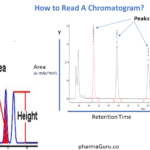
Peak Height and Area: Reflect the amount of compound in the sample. The area under the peak is especially important for accurate quantification.
Peak Shape: Ideally, peaks should be symmetrical. Broad, tailing, or fronting peaks can indicate problems such as column overload, poor separation, or detector issues.
How to Read A Chromatogram In HPLC and GC: Peak, RT (Retention Time) and RRT 5
What is a Chromatogram?
A chromatogram is a visual output (usually a graph) produced by chromatography systems, where the x-axis represents retention time (minutes) and the y-axis represents detector response (usually in milli-absorbance units – mAU for HPLC or detector signal for GC).
Each peak on the chromatogram corresponds to a compound that was separated and detected.
Unit of Chromatogram
Time (min) vs. Detector Signal. In HPLC, it is Time (min) vs. mAU
Key Elements of a Chromatogram: Definition
Source: Pharma Knowledge Forum
1. Peak
When the analyte goes into the detector, the detector converts it into the signal and sends that signal to the data processor, and the data processor converts that signal into a peak.
The peak is a two-dimensional graphical representation of the concentration of the analyte in the chromatogram. The x-axis represents time, and the y-axis represents analyte concentration in terms of detector response. The peak should be Gaussian or bell-shaped.
2. Retention Time (Rt)
The time taken by a compound to pass through the column and reach the detector. In other words, we can say that the time at which an analyte elutes in the chromatogram is called RT or retention time of that analyte
Rt is a unique characteristic of each compound under fixed conditions.
It is very useful for identification purpose.
3. Peak Area
The area under the peak is proportional to the quantity of the compound.
Used for quantification using calibration curves.
4. Peak Height
Sometimes used for quantification, but less accurate than area.
It can help assess detector sensitivity.
4. Relative Retention Time (RRT)
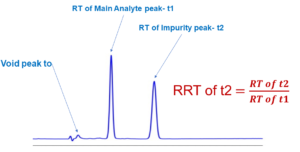
RRT is the relative location of two peaks. Generally, the relative location of the impurity peak, or any other peak, is calculated relative to the main analyte peak. Hence, we can say that Relative retention time is the ratio of the retention time of an impurity peak and the retention time of the main peak. It is denoted by RRT.
How to Read A Chromatogram In HPLC and GC: Peak, RT (Retention Time) and RRT 6
Used for quantification with calibration standards.
Step 6: Evaluate System Suitability
Check parameters like:
Retention Time Repeatability
Tailing Factor
Theoretical Plates (efficiency)
Resolution between critical peaks
Troubleshooting Abnormal Chromatograms
Observation
Possible Cause
Baseline Drift
Mobile phase instability, detector noise
Tailing Peaks
Column ageing, secondary interactions
Fronting Peaks
Overloading, poor injection
Broad Peaks
Column contamination, low flow rate
Missing Peaks
Poor injection, degraded sample
Conclusion
Mastering chromatogram interpretation is a must-have skill for QC analysts, ARD scientists, and regulatory professionals. With practice, you’ll be able to troubleshoot methods, improve resolution, and ensure robust data for audits and compliance.
1. X-Axis (Retention Time): Shows how long each compound takes to elute from the column; used to identify compounds. 2. Y-Axis (Detector Response): Indicates the signal strength (e.g., absorbance); higher peaks mean more of the compound is present. 3. Peaks: 4. Retention Time: Identifies the compound. 5. Area under the Peak: Used to quantify the amount of each compound. 6. Shape: Symmetrical peaks suggest good separation; distorted peaks may indicate issues.
What does a GC chromatogram tell you?
A GC (Gas Chromatography) chromatogram shows the separation of volatile compounds in a mixture. X-Axis (Retention Time): Identifies compounds based on how long they take to pass through the column. Y-Axis (Detector Response): Indicates how much of each compound is present. Peaks: Retention time helps identify each compound. Peak area is used to quantify the amount of each compound. It provides both qualitative (what’s in the sample) and quantitative (how much) information.
What is the difference between the chromatogram and the peak
One chromatogram contains multiple peaks, where one peak represents only one analyte or concentration of one analyte. Case studies: If the sample mixture contains phenol and Benzoic then its chromatogram will contain two peaks; one for Benzoic acid and a second for Phenol
Need More In-Depth Training?
At PharmaGuru.co, we offer online training and workshops in:
HPLC/GC Method Development & Validation
Data Integrity & Compliance
Audit Preparation & Regulatory Guidelines
Further Reading
LIQUID CHROMATOGRAPHY– MASS SPECTROMETRY: Robert E. Ardrey
HPLC METHODS FORRECENTLY APPROVED PHARMACEUTICALS: George Lunn
HPLC FOR PHARMACEUTICAL SCIENTISTS: YURI KAZAKEVICH | ROSARIO LOBRUTTO