Dr. Pramod Kumar Pandey — Pharmaceutical Trainer, Founder of PharmaGuru, Blogger & Analytical Expert with 31+ years of experience in leading global and Indian pharmaceutical companies.
Learn about GCMS in drug development; its principles, applications in industries, real-world case studies, and answers to frequently asked questions
GCMS (Gas Chromatography-Mass Spectrometry In Drug Development: Get Mastery In 9 Minutes
GCMS (Gas Chromatography-Mass Spectrometry is the combination of a Gas chromatograph and Mass Spectrophotometer.
It is a highly sensitive, accurate and reliable analytical technique, widely employed in drug development for both qualitative and quantitative analysis. Its exceptional sensitivity makes it particularly valuable for detecting and quantifying impurities, especially at trace levels, including nitrosamines and other genotoxic compounds.
In this article, I will provide skill-based insights into the principles, applications, advantages, limitations, case studies, and frequently asked questions related to GC-MS. By the end of this article, you will be well-equipped to develop GC-MS methods and predict the structure of unknown compounds during various stages of drug development.
Gas Chromatograph Mass Spectrometer
GCMS is the unique combination of a Gas chromatograph and Mass Spectrophotometer (Figure-1)
The function of GC is to separate different components from the sample mixture and send them one by one to the MS detector. The function of the MS detector is to break down each component into its different fragments (minor and major). These different fragments give structural information about the component.
GCMS = GC + MS
Figure-1
GCMS Instrument (source: pharmaknowledgeforum)
Principle of GC-MS
GC-MS is the integration of GC with a capillary column and an MS detector
GC with capillary column: The function of GC is to separate different components from the sample mixture and send them one by one into the MS
MS: The function of the MS is to break down each component into its different fragments (minor and major). These different fragments give structural information about the component. The major fragment is also used for the quantification of the component. The following are the main components of MS:
Interface: The function of the MS interface is to receive analyte from the capillary column and send it to the ion source.
Ion-source: The function of the ion source is to ionise the neutral molecules into their different fragments and send them to the Quadrupole. The pattern of this fragment is highly specific and acts as a fingerprint, which is used to structure characterisation or unknown compound identification.
Quadrupole: The quadrupole acts as a mass filter and separates ions based on the M/Z ratio. It is also called a mass analyser. It ensures that only a fragment of a specific mass travels towards the detector at a given time
MS Detector: The function of the Detector is to convert each fragment into a signal and send it to the data processor.
Data processor: The function of the Data processor is to convert all signals of an analyte into a mass spectrum
Types of GCMS ion sources
The Electron ionisation (EI) and chemical ionisation (CI) are used in most of the GC-MS instruments:
Electron ionisation (EI)
It is also called hard ionisation, and it is widely used for structure elucidation. The molecule which enters into the EI-ion source gets electron bombarded of 70 EV. Due to this bombardment molecule breaks down into different fragments. The pattern of this fragment is highly specific and acts as a fingerprint, which is used for the structure characterisation of the unknown compound. A stable (M+) or an unstable (M*) molecular ion may form due to this bombardment
M +e– → M+
M + e–→ M* →M1+ or M2+ or M3+
Chemical ionisation (CI)
It is also called soft ionisation, and it is used for mass determination. In this process, methane gas is passed at high pressure in the CI source. Since methane has a very low proton affinity* and hence it can transfer a proton to any molecule, and that is the reason it is used in the CI source for ionisation of the molecule. The CI process may go by the following mechanism:
CH4 + e- → CH4+, CH3+, CH2+
CH4+ + CH4 → CH5+ + CH3
CH3+ + CH4 → C2H5+ + H2
CH2+ + CH4 → C2H4+ + H2 and so on
Proton transfer
M +CH5+ →[M-H]+ + CH4 and so on
Note: Proton affinity for methane is 549/kJ/mol
What is the difference between EI and CI mode?
EI ionisation
CI ionisation
It is hard ionisation
It is soft ionisation
It is used only for the mass determination of a molecule
It is used only for the mass determination of a molecule
In EI ionisation molecule gets electron bombarded of 70 EV.
In CI ionisation, methane gas is passed at high pressure
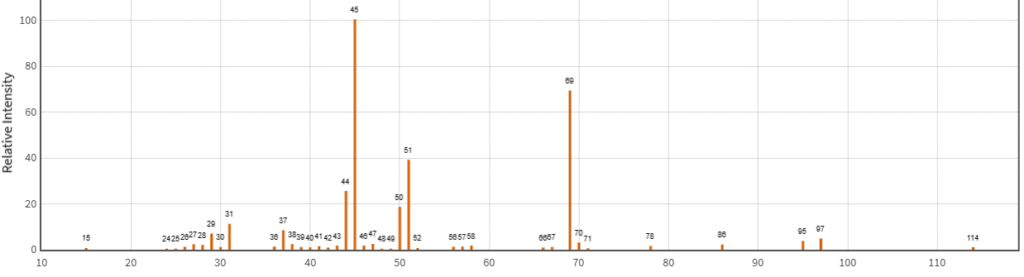
GCMS Spectra Representation
In GC-MS, the x-axis represents the m/z ratio, and the y-axis represents the relative intensity of the fragment (Figure-2)
Figure-2:
GCMS of Trifluoroacetic acid
SIM mode and MRM mode
SIM mode
SIM mode or selected ion monitoring mode allows the mass spectrometer to detect specific compounds with high intensity. In this mode single fragment is monitored. It is mainly used for quantification purposes.
MRM mode
MRM, or multiple reaction monitoring mode is used to collect data on different fragments of the molecule. It is used for structural characterisation purposes
Applications of GCMS
The following are the various applications of GCMS in the Pharmaceutical industry:
Identification of unknown components: It is very helpful in the identification and characterisation of unknown impurities during drug development
Identification of unknown organic volatile impurities: MS with GC-HS or GC-HS-MS Is very helpful in the identification and characterisation of organic volatile impurities or OVI
Mass determination of known or unknown or known molecules: It is required for structural characterisation e,g. during characterisation of the standard
Structure characterisation: MS in EI mode provides the specific pattern of fragments, which is very helpful for structural identification.
Quantification of Genotoxic impurities at TTC level or very low level (at ppm or ppb level) in pharmaceuticals: It is widely used in the industries for the quantification of various nitrosamines at very low level impurities
Content test: Quantification of residual pesticides
Drug metabolism studies: GCMS is widely used for drug metabolism studies. By analysing biological samples such as blood and urine, scientists know about the drug metabolites, which is very helpful in understanding metabolic pathways
Assay: Assay can be done by GC-MS. But it is not used for assay, considering the cost of analysis.
Apart from pharmaceutical industries, GCMS is the following industries for various tests:
Sports anti-doping: This is the main tool used in the anti-doping laboratory to test athletes’ urine samples for prohibited performance-enhancing drugs, for example, antibiotics and steroids
Structure characterisation of unknown compounds: The Structure of unknown compounds can easily be predicted using different fragments in EI mode or using the GSMS spectrum
Disadvantages
The following are the disadvantages of the GC-MS:
High cost: It is a costly instrument, and hence, small industries can not afford it
Not suitable for non-volatile material compounds: It is only suitable for volatile compounds, and non-volatile compounds can not be analysed
Long analysis time: The System needs a longer time for stabilisation. Secondly, it takes more time to to stabilise the system after changeover from EI mode to CI mode and vice versa.
Special skill: It requires the dedicated and well-trained person to operate the instrument. The person must have knowledge of organic chemistry.
Needs extra pure chemicals and gases: It needs extra pure (G-MS grade) solvents and gases to perform the analysis. It increases the cost of analysis
Structure Characterisation By GCMS
Use the following steps to identify the structure:
Write down all EI (electron ionisation) fragments of the unknown molecule
Take the probable EI spectrum of the unknown compound from the EI library
Write down all solvents or chemicals used at that stage in the process
Now correlate the fragments, probable structure obtained from EI library and solvents or chemicals used in the process
Conclude the result and make the report
Case Study:
An unknown compound that gives major fragments of 29D, 43D, 45D, 51D and 60D in EI mode. In CI mode, it gives the mass of 60D.
Interpretation
The EI spectrum predicts the closest structure of Acetic acid.
Secondly, Acetic acid is also used in the process
Therefore, the above masses are due to the following fragments of acetic acid:
Molecular ion (M⁺)
The molecular ion for acetic acid is typically observed at m/z 60: CH3COOH+ (m/z 60)
Loss of the hydroxyl group (COOH → CO)
One common fragmentation pathway is the loss of the -OH group from the carboxyl group. This produces an ion at: CH3CO+(m/z 43)
This fragment is stable and often one of the most prominent peaks in the EI mass spectrum. I
Loss of CO₂ (Decarboxylation)
Acetic acid can also undergo decarboxylation, losing a molecule of carbon dioxide (CO₂). This process is common for carboxylic acids. The resulting fragment ion is: CH3+(m/z 15)
This is a methyl ion, a very stable species. Decarboxylation is a strong fragmentation pathway for carboxylic acids, and this peak is often observed.
Cleavage of the C–C bond (Formation of C₂H₅⁺)
Another fragmentation pathway involves the cleavage of the C–C bond in acetic acid. This produces an ethyl ion C2H5+(m/z 29)
Conclusion
The control, quantification, characterisation, and identification of highly carcinogenic compounds would be extremely challenging – if not impossible – without the use of GC-MS. This is why GC-MS plays a crucial role in pharmaceutical research and development. Hopefully, this post has helped clarify the importance of GC-MS and deepened your understanding of its applications.
You may also want to check out other articles on my blog, such as::
GC-MS is used for mass determination, identification, quantification and characterisation of unknown or known compounds
What is the principle of GC-MS?
GC-MS is the combination of GC with a capillary column and mass. GC separate the different components of the sample mixture and mass identifies each component.
What is the difference between GC and GC-MS?
GC-MS is the combination of GC with a capillary column and mass spectrometry. GC separate the different components of the sample mixture and mass identifies each component.
Why is GC-MS best for drug analysis?
Due to its sensitivity, reliability, precision and accuracy, GC-MS is best for drug analysis
What are the advantages of GC-MS?
GCMS is highly sensitive, reliable, precise and accurate technique
What is the use of the EI and CI source in GC-MS?
EI gives structural information about the molecule, whereas CI gives mass of the molecule
What is mass spectrometry?
Mass spectrometry is an analytical technique used to measure the mass-to-charge ratio (m/z) of ions in a sample. These measurements can be used to determine the exact molecular weights of the sample’s components
What is gas chromatography mass spectrometry?
Gas chromatography–mass spectrometry (GC–MS) is a powerful analytical technique that combines the separation capabilities of gas chromatography with the identification power of mass spectrometry to detect, identify, and characterise compounds within a sample
Abbreviations
GC: Gas chromatography
HS: Head space
MS: mass spectrometry
EV: Electron volt
EI: Electron ionisation
CI: Chemical ionisation
M/Z: Mass/charge
References
Interpretation of mass spectra; Fred W. McLafferty
LIQUID CHROMATOGRAPHY– MASS SPECTROMETRY: Robert E. Ardrey