

These 12 proven GC column maintenance tips to extend column life, improve peak sharpness, reduce downtime, and achieve reliable gas chromatography results
A gas chromatography (GC) column is the heart of every GC system. No matter how advanced your instrument is, poor column maintenance can lead to peak tailing, ghost peaks, baseline noise, poor resolution, and expensive replacements. Most GC column failures are preventable with proper handling and routine maintenance.
In this guide, we’ll cover 12 practical GC column maintenance tips that will help extend column life, improve analytical performance, and reduce downtime in your laboratory.
A well-maintained GC column offers several benefits:
Whether you’re working in pharmaceutical, environmental, food, petrochemical, or research laboratories, these maintenance practices can significantly improve your chromatography performance.
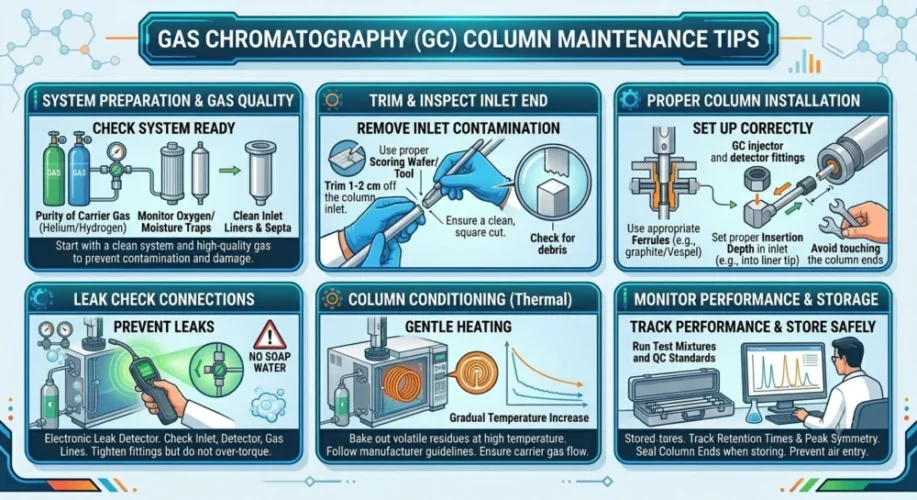
The following are the 12 GC maintenance tips every GC chromatographer must know:
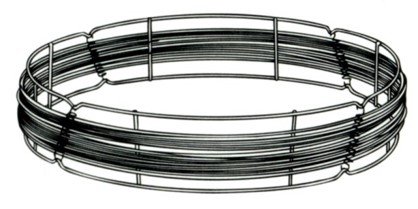
Proper storage is the first step toward extending column life.
When a GC column is not in use:
A properly stored column remains clean and ready for future analysis.
The inlet end of a GC column experiences the highest contamination because all samples enter from this side.
If you notice:
Cut approximately 10–20 cm from the inlet end using a ceramic scoring wafer.
Regular trimming removes contaminated stationary phase and restores column performance without replacing the entire column.
Tip: Always make a clean, square cut to ensure proper installation.
Incorrect installation is one of the most common causes of poor chromatography.
Always ensure:
Even a perfectly maintained column will perform poorly if installed incorrectly.
Carrier gas quality directly affects column longevity.
Use 99.999% (5.0 grade) or higher purity gases such as:
Impurities like oxygen and moisture gradually damage the stationary phase and reduce column performance.
Using gas purification traps provides additional protection.
Even a tiny leak can introduce oxygen into the system.
Oxygen exposure at elevated temperatures permanently damages the stationary phase.
Use an electronic leak detector to inspect:
Leak testing is especially important after:
Routine leak checks can prevent costly column replacement.
Conditioning removes residual contaminants and stabilizes the stationary phase before sample analysis.
Always follow the manufacturer’s recommended conditioning procedure after:
Skipping this step may result in unstable baselines and unwanted background peaks.
This is one of the most critical GC maintenance rules.
Before increasing oven temperature:
Heating a column without carrier gas allows oxygen to oxidize the stationary phase, causing irreversible damage.
Remember this Expert Tips: Gas flow first. Heat second.
Not every solvent or sample is compatible with every GC column.
Avoid injecting:
Whenever possible:
Cleaner samples lead to cleaner columns and longer service life.
Injector temperature should be high enough to completely vaporize the sample—but not so high that it causes thermal degradation.
An incorrect injector temperature can cause:
Select the injector temperature based on the boiling points and thermal stability of your analytes.
Every GC column has a manufacturer-specified maximum operating temperature.
For longer column life:
Operating slightly below the maximum temperature significantly slows stationary phase degradation.
Detector temperature should generally be 10–20°C higher than the highest oven temperature used in the analytical method.
This helps prevent analyte condensation inside the detector and improves peak quality.
Proper detector temperature contributes to:
A contaminated inlet is one of the biggest sources of GC problems.
Replace these components regularly:
Replacement frequency depends on:
Dirty inlet components can introduce contamination into the column, shorten its lifespan, and negatively impact analytical results.
Preventive maintenance is far less expensive than replacing a damaged column.
In addition to the maintenance practices above:
These simple habits can add months—or even years—to your GC column’s service life.
Watch for these warning signs:
Addressing these issues early can often restore performance before permanent damage occurs.
A GC column is a valuable investment, and proper maintenance is essential to protect both its performance and lifespan. By following these 12 best practices—from proper storage and leak checking to using high-purity carrier gas and replacing inlet consumables—you can achieve reliable chromatographic results while minimizing maintenance costs.
Consistent preventive care not only extends column life but also improves data quality, enhances laboratory efficiency, and reduces unexpected instrument downtime. Small maintenance habits today can save significant time and expense in the future.
Related:
Trim the inlet end whenever you observe peak tailing, ghost peaks, increased baseline noise, or reduced efficiency. For heavily used systems, periodic trimming as part of preventive maintenance can also help maintain performance.
se 99.999% (5.0 grade) or higher purity carrier gas to minimize oxygen and moisture contamination that can damage the stationary phase
The detector temperature is typically maintained 10–20°C higher than the maximum oven temperature used in the analytical method to prevent analyte condensation.
Why should I never heat a GC column without carrier gas flow?
Heating without carrier gas allows oxygen to contact the stationary phase at high temperatures, causing irreversible oxidation and significantly shortening column life.
How often should GC inlet consumables be replaced?
Replacement frequency depends on sample cleanliness and workload. Laboratories analyzing dirty or complex matrices should replace septa, liners, and O-rings more frequently than those handling clean samples.
Quick Links