

Asymmetry Factor Vs Tailing Factor in HPLC; Tailing factor is measured at 5% of the peak height whereas asymmetry factor is measured at 10% of the peak height.
Asymmetry Factor Vs Tailing Factor in HPLC; The main difference between the asymmetry factor and the tailing factor in HPLC lies in the height at which the peak width is measured and the mathematical formula used to calculate the peak distortion. While the tailing factor is measured at 5% of the peak height, the conventional asymmetry factor is typically measured at 10% of the peak height.
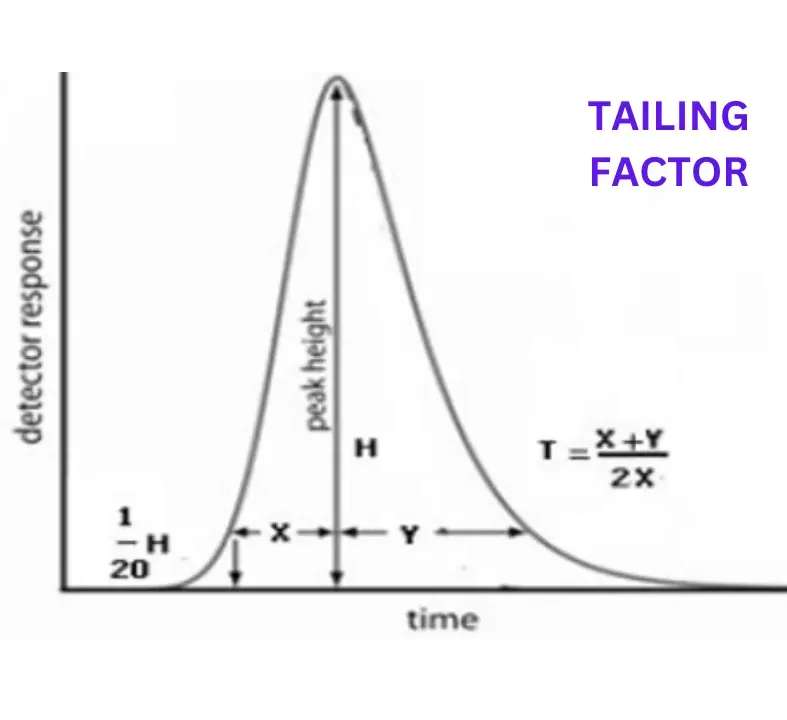
Most pharmacopeial methods recommend a tailing factor below 2.0, while values closer to 1.0 indicate excellent chromatographic performance.
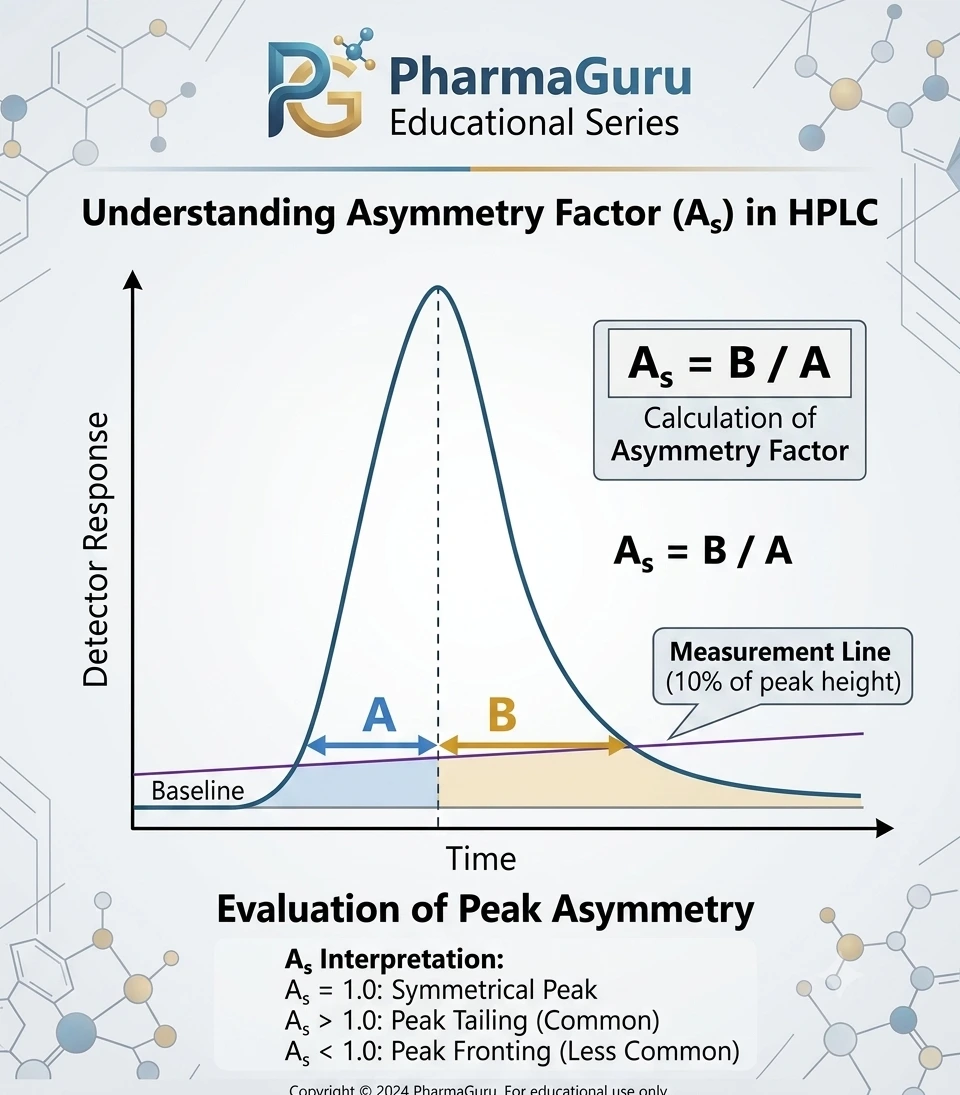
The Asymmetry Factor (As) is another parameter used to evaluate chromatographic peak symmetry. Unlike the tailing factor, it is measured at 10% of the peak height.
As = B / A
Where:
Because measurements are taken higher on the peak profile, the asymmetry factor often detects peak distortion differently than the tailing factor.
| Feature | Asymmetry Factor (As) | Tailing Factor (T) |
|---|---|---|
| Measurement Height | 10% of peak height | 5% of peak height |
| Formula | As = B/A | T = W₀.₀₅ / 2f = (X+Y)/2X |
| Standard Reference | Common chromatographic practice | USP System Suitability |
| Evaluates | Peak symmetry | Peak tailing |
| Ideal Value | 1.0 | 1.0 |
| Indicates Tailing | As > 1 | T > 1 |
| Indicates Fronting | As < 1 | T< 1 |
| Widely Used In | Method development | Routine Analysis |
The biggest distinction is the location where the peak width is measured.
This difference affects the calculated value, especially for distorted peaks.
The two parameters use different equations.
Tailing Factor
T= (X+ Y) / 2X
Asymmetry Factor
As = B / A
Because of these different calculations, the numerical values are not directly interchangeable.
The USP specifically recommends the Tailing Factor for system suitability testing.
However, many research laboratories and chromatography software packages also report the Asymmetry Factor during method development.
Although the Asymmetry Factor and Tailing Factor both evaluate HPLC peak symmetry, they are calculated differently and serve slightly different purposes. The Tailing Factor is measured at 5% of the peak height and is the preferred metric for USP system suitability, whereas the Asymmetry Factor is measured at 10% of the peak height
Both talks about deviation in peak shape. The Tailing Factor is preferred for USP compliance and system suitability, while the Asymmetry Factor is often more useful during method development .
Measuring at 5% captures the far end of the chromatographic peak where tailing is most noticeable, making it suitable for regulatory system suitability testing.
No. Since they use different measurement heights and formulas, their numerical values are not directly interchangeable.
An ideal chromatographic peak has:
Values close to 1 indicate excellent peak symmetry.
Related:
Quick Links