Dr. Pramod Kumar Pandey — Pharmaceutical Trainer, Founder of PharmaGuru, Blogger & Analytical Expert with 31+ years of experience in leading global and Indian pharmaceutical companies.
Learn about HETP (Height equivalent to a theoretical plate) with applications with applications, Optimisation & Case Study.
HETP (Height Equivalent To A Theoretical Plate) In HPLC: Applications | Optimisation | Case Study
HETP (Height Equivalent to a Theoretical Plate), also known simply as H, is one of the key parameters used to assess the efficiency of a column’s separation. HETP represents the height of the column required for the analyte to reach equilibrium between the stationary and mobile phases during separation. A lower HETP value indicates a more efficient column and better separation performance.
This article provides a comprehensive overview of HETP, covering its definition, the formula used for its calculation, and the factors that influence it. You will also explore its practical applications in chromatography, examine real-world case studies, and find answers to frequently asked questions to help you understand and optimise HETP in your analytical work.
HETP (Height equivalent to a theoretical plate)
HETP (Height equivalent to a theoretical plate) is the property of the column, which is defined as the height of the column required by the analyte to achieve equilibration between the stationary phase and the mobile phase. It is denoted by HETP or H.
HETP Calculation Formula
The following formula is used to calculate the HETP:
HETP (Height Equivalent To A Theoretical Plate) In HPLC: Applications | Optimisation | Case Study 4
When N will be 1, then HETP = L
Hence, HETP can be defined as “HETP is the length of the column which represents 1 (one) theoretical plate. It means lower the HETP and better the column.
Difference between HETP (Height equivalent to a theoretical plate and Column efficiency
HETP
Column efficiency
The higher the value of HETP, the better the column
The higher the value of HETP better the column
Lower is better
Higher is better
It is represented in length (e.g., mm, cm)
It has no dimension/unit
It tells about packing/column quality (how efficient each unit length is)
It tells about separation power of the column
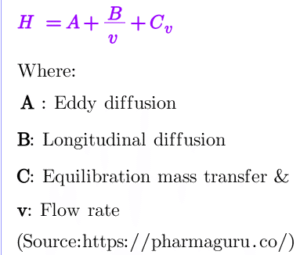
Van-Deemter Equation (Relationship between HETP and flow rate)
HETP (Height Equivalent To A Theoretical Plate) In HPLC: Applications | Optimisation | Case Study 5
Factors Affecting HETP
The following are the HETP controlling factors in HPLC:
Column efficiency: HETP is inversely proportional to the column efficiency
Column length: L is directly proportional to the column length
Particle size: HETP is directly proportional to the particle size.
Column temperature: HETP is inversely proportional to the column temperature
Injection volume: HETP is directly proportional to the buffer concentration
Sample concentration: HETP is directly proportional to the sample concentration
Eddy diffusion: HETP is directly proportional to the Eddy diffusion.
Longitudinal diffusion: HETP is directly proportional to Longitudinal diffusion.
Equilibration mass transfer: HETP is directly proportional to the Equilibration mass transfer
Flow rate: HETP is directly proportional to the flow rate
Relationship between HETP (H) and h (Reduced plate height)
HETP (Height Equivalent To A Theoretical Plate) In HPLC: Applications | Optimisation | Case Study 6
Applications
HETP helps to assess the efficiency of a chromatographic separation process. The following are the various applications of HETP:
Performance Evaluation: HETP is used to assess the efficiency of chromatographic columns. A lower HETP indicates better separation performance and higher resolution in separating compounds.
Optimisation of Separation: By monitoring HETP, one can optimise the flow rate, column dimensions, and other parameters to improve the quality of separation in both analytical and preparative chromatography.
Column Design and Selection: It helps in selecting or designing the most suitable columns for specific separations by considering the required resolution and efficiency.
Very helpful in selecting the column during chromatographic method development
The lower the value of HETP, the better is the method/column
The lower the value of HETP sharper the peak
Distillation Processes
Designing Distillation Columns: In distillation, HETP is used to design and optimise distillation columns. The number of theoretical plates in a column correlates with its separation efficiency, and a lower HETP means fewer plates are needed for the same separation efficiency.
Optimisation of Operating Conditions: By adjusting factors like reflux ratio, feed composition, and column temperature, operators can reduce HETP, improving energy efficiency and product purity in industrial distillation processes.
Process Engineering
Scale-Up: HETP is used when scaling up laboratory separations to industrial scales. It helps predict how separation efficiency changes when moving from small laboratory columns to large industrial equipment.
Food and Beverage Industry
Purification of Food Ingredients: In the production of flavorings, additives, or essential oils, HETP helps optimize separation processes for extracting desired compounds with minimal loss and maximum purity.
Pharmaceutical Industry
Purification of Drugs and Active Pharmaceutical Ingredients (APIs): HETP is important in optimizing the separation of active ingredients from impurities or solvents during the production of pharmaceuticals. It helps ensure high purity and consistency of the final product.
Petroleum and Petrochemical Industries
Refining and Fractionation: In the refining of crude oil or gas, HETP is used to optimize the distillation processes involved in separating various hydrocarbon fractions such as gasoline, diesel, and kerosene.
Chemical Analysis
Analytical Chemistry: In chemical analysis, HETP provides valuable insights into column efficiency and can be used for the validation of chromatographic methods, particularly in the analysis of complex mixtures.
HETP Case Study: Optimisation of HPLC
Background:
A pharmaceutical laboratory is analysing a mixture containing paracetamol, caffeine, and aspirin in a commercial tablet formulation using HPLC. The aim is to optimise the separation to achieve sharp peaks and baseline resolution within the shortest run time.
Objective:
Evaluate and compare the efficiency of different HPLC columns using HETP as a metric and identify the best conditions for optimal separation.
HPLC Condition Setup:
Mobile Phase: Methanol:Water (60:40, v/v)
Flow Rate: 1.0 mL/min
Detector: UV at 254 nm
Sample: Tablet extract containing paracetamol, caffeine, and aspirin
Each sample was injected, and the following data were collected:
Column
Compound
Retention Time (RT) (minute)
Peak Width (Wb) (minute)
HETP (mm)
A
Paracetamol
3.2
0.42
0.21
A
Caffeine
5.1
0.48
0.28
B
Paracetamol
2.7
0.33
0.13
B
Caffeine
4.2
0.38
0.19
C
Paracetamol
3.4
0.49
0.27
Note: HEPT was calculated using the HETP = L/N formula
Summary and Conclusion
Column B (3 µm particles, shorter length) showed the lowest HETP values, indicating higher efficiency and better separation in a shorter time.
While Column A offered decent efficiency, its longer length and larger particles resulted in higher HETP.
Column C (C8) had poorer retention and resolution, especially for aspirin, due to its less hydrophobic nature.
Conclusion
HETP is widely used in chromatographic separation in the pharmaceutical industry. Hopefully,y this article has cleared all your doubts related to HETP, and you can now use it effectively during HPLC separation method development. Write your opinion/ question related to this article in the comment section, and I will answer it on a priority basis.
HETP (height equivalent to a theoretical plate) is the property of the column, which is defined as the height of the column required by the analyte to achieve equilibration between the stationary phase and the mobile phase. It is denoted by HETP or H.
How do you calculate the HETP of a chromatography column?
HETP = L/N; where L is the length of the column (in millimeter/centimeter/meter) and N is the theoretical plate or column efficiency
What is the significance of HETP?
Lower the HETP and better the column. HETP = L/N; where L is the length of the column (in millimetres/centimetres/meter) and N is the theoretical plate or column efficiency.
What is the relation between HETP and the theoretical plate?
HETP is inversely proportional to theoretical plate
What is the difference between HETP and column efficiency or theoretical plate?
The difference between HETP and column efficiency or theoretical plate is that HETP (Height Equivalent to a Theoretical Plate) is a measure of column performance, while column efficiency or theoretical plate is a measure of the number of theoretical plates in the column. HETP and flow rate have an inverse relationship – as flow rate increases, HETP decreases. HETP and reduced height have a direct relationship – as reduced height increases, HETP also increases. HETP is used to evaluate the performance of packed columns in chromatography and distillation processes.
What is the relationship between HETP and flow rate?