

ReLearn Method Reproducibility Vs. Intermediate Precision in Analytical Method Validation; key difference with real case studies and FAQS
Method Reproducibility Vs. Intermediate Precision in Analytical Method Validation: Introduction
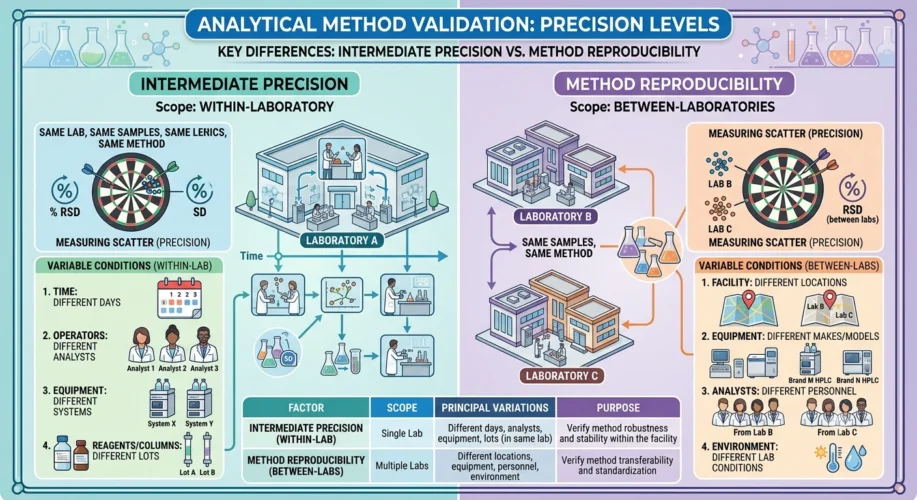
Reproducibility and Intermediate precision are two key parameters of analytical method validation described in ICH Q2(R2. On one hand, intermediate precision evaluates the variation observed within the same laboratory across different days, analysts, or instruments; on the other hand, reproducibility measures the variation observed across different laboratories involving different days, analysts, and instruments.
In this article I will explain the key differences, testing approaches, and practical examples of both parameters.
Intermediate Precision evaluates the variability of an analytical method within the same laboratory. It demonstrates that the method produces consistent results despite normal day-to-day variations that may occur during routine analysis.
The study typically evaluates the effect of changes in:
The purpose is to ensure that routine laboratory variations do not significantly affect the analytical results.
If three samples are not available:
The acceptance criteria are established in the analytical method or validation protocol. A common criterion is:
Method Reproducibility evaluates the variability of an analytical method between different laboratories. It confirms that the method can generate comparable results regardless of where it is performed.
The study evaluates the effect of changes in:
If sample availability is limited:
The acceptance criteria are generally the same as those used for intermediate precision.
A common requirement is:
Data of the vreproducibility test can be used for technology transfer.
| Parameter | Intermediate Precision | Method Reproducibility |
|---|---|---|
| Laboratory | Same laboratory | Different laboratories |
| Analysts | Different analysts | Different analysts |
| Instruments | Different instruments | Different instruments |
| Column Lot | Different column lots | Different column lots |
| Day | Different days | Different days |
| Purpose | Demonstrates consistency within one laboratory | Demonstrates consistency across laboratories |
| Typical Application | Method validation | Method validation and analytical method transfer |
One analyst from Analytical R&D and one analyst from Quality Control (QC) analyzed three pharmaceutical samples according to the validated analytical method. The analyses were performed on different days using different instruments and different column lots.
| Sample | Analyst | Assay (%) | Difference (%) |
|---|---|---|---|
| xxxxx01 | R&D* | 12.8 | |
| QC | 12.9 | 0.8 | |
| xxxxx02 | R&D | 12.8 | |
| QC | 13.0 | 1.6 | |
| xxxxx03 | R&D | 12.8 | |
| QC | 13.0 | 1.6 |
The method meets the reproducibility acceptance criteria because the differences between the results obtained by the two laboratories are less than 4.0%.
Two analysts from the same laboratory analyzed three pharmaceutical samples according to the validated analytical method. The analyses were carried out on different days using different instruments and different column lots.
| Sample | Analyst | Assay (%) | Difference (%) |
|---|---|---|---|
| xxxxx01 | Analyst 1 | 12.8 | |
| Analyst 2 | 12.9 | 0.8 | |
| xxxxx02 | Analyst 1 | 12.8 | |
| Analyst 2 | 13.0 | 1.6 | |
| xxxxx03 | Analyst 1 | 12.8 | |
| Analyst 2 | 13.0 | 1.6 |
Although Intermediate Precision and Method Reproducibility both assess the precision of an analytical method under varying conditions, they differ in their scope.
Understanding these differences helps ensure that analytical methods remain robust, reliable, and suitable for their intended use throughout the product lifecycle.
You May Like
FAQs
Intermediate precision measures variability within the same laboratory under different conditions (e.g., different days, analysts, instruments), while reproducibility measures variability between different laboratories, assessing method performance across different locations and setups.
Further Reading
Quick Links