

Learn void volume, dwell volume, and dead volume in chromatography—three key concepts that explain how mobile phase moves through an HPLC column and system.
In HPLC, void volume refers to the volume within the column that is not occupied by stationary phase particles but is instead filled with the mobile phase. Dwell volume (also known as gradient delay volume and denoted as Vᴅ) is the volume of mobile phase between the solvent mixing point and the column inlet in a gradient system. Dead volume refers to the volume of mobile phase between the injection point and the detector, excluding the void volume of the column. It includes all system components, such as tubing and connectors, that contribute to band broadening but are not involved in the separation process.
Void Volume, Dead Volume and Dwell Volume in HPLC play a critical role in achieving accurate and reproducible results. Drawing from practical experience, I aim to clarify these essential concepts and offer clear guidance on how to measure or calculate them. This post will not only help you understand what each term means, but also how they impact chromatographic performance. By the end, you will be equipped to confidently answer key questions such as:
Whether you’re a beginner in analytical chemistry or looking to refine your skills, this guide will serve as a practical reference for mastering foundational chromatographic concepts.
You may like:
How To Control Impurities In Pharmaceuticals: Get Mastery In …
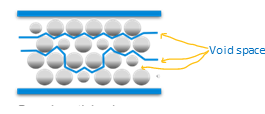
In the HPLC column, some of the space between the stationary phase is not occupied by the stationary phase; that space is called void space. The same void space can be occupied by solvent or mobile phase.
The volume of the solvent/mobile phase in a liquid chromatography column is called the Void volume. In another way, we can say that the void volume is the volume of the column not occupied by the support particles. It includes volume between the particles as well as volumes of the pores of the particle. It is denoted by V.
Void volume is calculated by the following formula:
Void volume (V) = π)d2l (f/4)
Where:
Suppose the column dimension is (150 x 2.1)mm and f is 0.70. Then the void volume will be:
V = 3.14159265359 x (2.1)2 x 150 x (0.70/4) = 0.37ml
The Dead volume is the volume of the mobile phase of the HPLC system between point injection to point of detection. The volume of the void space of the column is not considered in the dead volume.
The Dead volume can be measured by replacing the column with a zero dead volume connector or union
Procedure
Dead Volume = (t – t0) x Flow rate of mobile phase
Where: t = time of injection, and to = Peak elution time
Calculate the Dead volume using the following data:
The Dwell volume is the volume of the mobile phase of the gradient HPLC system between the mixing chamber and column inlet. It is also called the Gradient delay volume. It is denoted by VD. It is the primary function of the pump.
The following mobile phase (Table-1), chromatographic condition (Table-2), formula (equation-1 and equation-2) and gradient curve (figure-1 -1) are used to calculate the Dwell volume.
Mobile phase gradient
| Time (minute) | Mobile phase A – water (V/V) | Mobile phase A – 0.1% Acetonitrile (V/V) |
| 0 | 100 | 0 |
| 20 | 0 | 100 |
| 30 | 0 | 100 |
Chromatographic condition
| Column | (1m x 0.12mm), PEEK capillary tubing can be used |
| Flow rate | 2ml/minute |
| Wavelength | 265nm |
Boost your pharma career with PharmaGuru’s expert-led online courses.: Online Pharma Course (Training)
Dwell volume (D) can be calculated by the following formula
Where: D is the Dwell volume, F is the flow rate, and tD is the Dwell time
tD can be calculated by the following equation 2:
Where:

Once the gradient is completed, the chromatogram looks as in the above figure. The initial flat baseline represents 0% acetone (100% A), and the final baseline is 0.1% acetone (100% B). The sloping line is the transition between the two. The following approaches are used to calculate the Dwell time (tD).
The peak due to void volume is called the void volume peak or unretained peak. it is denoted by to
to can be calculated using the following procedure -1 and procedure-2
t0 = Void volume/Flow rate of the mobile phase
Case study: Suppose the column dimension is (150 x 2.1)mm and the flow rate of the mobile phase is 0.2 ml/minute. Then to will be (0.30/2) = 1.85 minutes
The chromatographic terms dead volume, dwell volume, void volume, chromatogram, peak, unretained peak, retention time, and relative retention time are fundamental concepts in chromatographic analysis and method development. I hope this explanation has helped clarify any doubts you may have regarding these terms.
If you have any further questions or feedback, please feel free to leave a comment below—I’ll be happy to respond promptly.
You may also want to check out other articles on my blog, such as:
Abbreviations:
References:
Dwell volume (also known as gradient delay volume and denoted as Vᴅ) is the volume of mobile phase between the solvent mixing point and the column inlet in a gradient system
Dead volume refers to the volume of mobile phase between the injection point and the detector, excluding the void volume of the column. It includes all system components
The peak due to void volume is called the void volume peak or unretained peak. it is denoted by to
You must be logged in to post a comment.
Quick Links
Very helpful topic void peak concept clear
Thanks sir