

Learn about Loss on Drying test, purpose, procedure, acceptable limits , case studies and FAQs
Loss On drying Test (LOD Test) is conducted for pharmaceuticals. It measures the total content of water and volatile substances (such as residual solvents like methanol and ethanol) by applying heat—or a combination of heat and vacuum—at a specified temperature. This helps ensure the drug’s stability, purity, and proper shelf-life.
LOD testing is used for APIs, excipients, intermediates, and finished pharmaceutical products to help control material quality, manufacturing consistency, stability, and compliance with applicable specifications.
The test is commonly performed using a drying oven, although thermogravimetric analysis (TGA) and infrared/halogen moisture analyzers may also be used where appropriate.
In this article, you will learn why, how, and at what limit the LOD test is conducted.
The primary purpose of LOD testing is to determine the amount of volatile material present in a pharmaceutical substance under defined conditions.
LOD can help to:
Excessive moisture can affect properties such as flowability, compressibility, chemical stability, microbial susceptibility, and product performance, depending on the material.
LOD measures the loss in sample mass after drying under specified conditions.
It may include:
Therefore LOD is not a specific test for water.
If the objective is to determine water specifically, a technique such as Karl Fischer titration may be more appropriate because it is designed to selectively determine water.
Three commonly used approaches are:
The sample is heated at a specified temperature for a specified period or until constant weight is achieved.
This is one of the most widely used approaches because it is:
TGA continuously measures the change in sample mass as temperature is increased or maintained under controlled conditions.
It can provide additional information about different stages of mass loss and thermal behavior.
The sample is heated using an infrared or halogen source while the instrument continuously monitors the change in weight.
Infrared/Halogen Moisture Analyzer method can provide rapid results and is particularly useful for in-process or routine applications when the method has been properly developed and validated.
The drying oven method is widely used in pharmaceutical laboratories because it requires relatively simple equipment and is economical for routine analysis.
A typical setup includes:
The actual test conditions—including sample quantity, temperature, pressure, drying time, and endpoint—should always be taken from the applicable pharmacopoeial monograph or validated analytical procedure.
The general principle is straightforward:
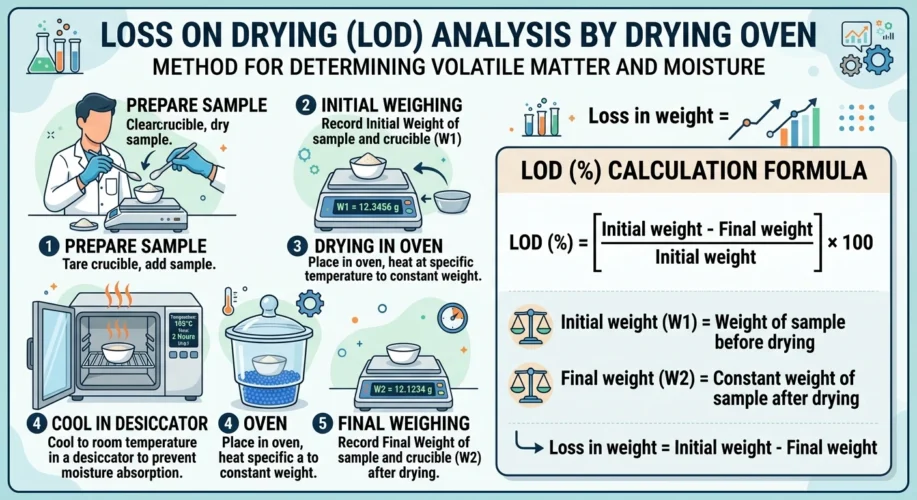
The basic calculation is:
LOD (%) = [(Initial weight − Final weight) / Initial weight] × 100
Suppose:
Then:
LOD = [(2.000 − 1.960) / 2.000] × 100
LOD = 2.0%
The result should then be compared with the specification applicable to that particular material.
USP <731>, Loss on Drying, provides general guidance for determining loss on drying. However, the applicable monograph or validated method should always be followed when it specifies different conditions.
Important considerations include:
A representative sample should be used. The material may need to be mixed thoroughly and, where appropriate, reduced to a suitable particle size to promote uniform drying.
The amount of sample depends on the applicable procedure. A quantity around 1–2 g is commonly encountered, but this should not be treated as a universal requirement.
A suitable, clean, dry, and previously weighed weighing bottle is used. The sample should be distributed appropriately to facilitate uniform drying.
The drying temperature must be controlled according to the specified method. For a method specifying 105°C, appropriate temperature control is essential because LOD is affected by both temperature and drying time.
After drying, the sample is normally cooled in a desiccator before weighing. This minimizes the possibility of the dried material absorbing moisture from the surrounding atmosphere.
When a procedure states “dry to constant weight,” the sample is dried, weighed, and subjected to additional drying until the specified constant-weight criterion is achieved.
The exact acceptance criterion and procedure should be taken from the applicable pharmacopoeial requirement rather than assumed to be the same for every material.
105°C is a common drying temperature, but it is not a universal requirement for every pharmaceutical material.
It is widely used because it provides sufficient thermal energy to remove water and other volatile components from many relatively thermally stable materials without requiring excessively high temperatures.
There are several reasons for its widespread use:
A temperature around 105°C provides an adequate driving force for removing moisture from many materials.
Drying at this temperature generally provides a reasonable balance between drying efficiency and sample stability for suitable materials.
105°C has been used extensively in pharmaceutical, chemical, food, and other analytical applications, making it a familiar and practical reference condition.
Many APIs and excipients can tolerate 105°C for the duration of the test. However, this cannot be assumed for every pharmaceutical substance.
Some materials may:
For such materials, a different temperature, pressure, or analytical technique may be required.
It is not accurate to say that 105°C is used simply because water boils at 100°C.
Boiling point alone does not determine the appropriate LOD temperature. The result depends on factors such as vapor pressure, matrix interactions, sample composition, thermal stability, particle size, drying time, and pressure.
Vacuum drying is used when the material requires different drying conditions from ordinary atmospheric drying.
The key principle is:
Reducing pressure lowers the boiling point and vapor pressure requirements for volatile components, allowing them to be removed at a lower effective thermal stress.
However, an important distinction should be made: 105°C under vacuum should not be described as a universal or standard LOD condition. It is used only when the applicable monograph or validated procedure specifies it.
Under reduced pressure, water and volatile solvents can evaporate at lower temperatures than they would at atmospheric pressure.
Vacuum can facilitate removal of volatile material while reducing the need for prolonged exposure to high atmospheric-temperature conditions.
Reduced pressure can enhance the removal of certain volatile substances from porous or complex matrices.
Vacuum reduces the amount of oxygen surrounding the sample, which may be beneficial for some oxidation-sensitive materials. However, vacuum should not automatically be considered an inert atmosphere.
Vacuum drying may be appropriate when:
The pressure, temperature, drying time, sample quantity, and endpoint must be clearly defined in the analytical procedure.
Continue Reading
LOD can be applied to:
Used to monitor moisture and volatile content of active pharmaceutical ingredients.
Helps control moisture levels that may influence processing and finished-product performance.
Can be used during manufacturing to monitor the effectiveness of drying operations.
Depending on the monograph or validated method, LOD may be used for tablets, capsules, powders, granules, and other dosage forms.
For finished products, representative sampling is important because moisture may not be uniformly distributed throughout the batch.
LOD has several advantages:
Despite its usefulness, LOD has important limitations.
LOD cannot tell you whether the lost mass was:
If the sample decomposes during heating, the measured loss may include degradation products rather than simply moisture or volatile matter.
Different forms of water—including surface, capillary, adsorbed, and chemically associated water—may not be removed in the same manner.
Temperature, pressure, sample thickness, particle size, drying time, and cooling conditions can influence the measured result.
A sample containing volatile organic solvents can produce a high LOD even when its actual water content is relatively low.
There is no single universal LOD limit for all pharmaceutical products.
The acceptable limit depends on:
For example, one material may have an LOD specification of NMT 0.5%, while another may have a specification of NMT 2.0%, 3.0%, or a different value.
Therefore, the correct answer to the interview question “What is the LOD limit?” is:
The LOD limit is material-specific and must be taken from the applicable monograph, specification, or validated analytical procedure. There is no universal LOD limit for all pharmaceuticals.
LOD results can be affected by:
Good laboratory practices and a validated analytical procedure are therefore essential for obtaining reliable results.
LOD measures the total mass lost during the specified drying procedure. This can include water, residual solvents, and other volatile substances.
No. LOD is not specific for water. If a sample contains volatile solvents or other volatile substances, they may also contribute to the LOD result.
105°C is a commonly established drying condition that provides effective removal of moisture and other volatile components from many thermally stable materials. However, 105°C is not a universal requirement; the applicable monograph or validated method determines the actual conditions.
Vacuum reduces pressure, which facilitates evaporation of volatile components at lower effective boiling temperatures and can reduce thermal stress on suitable heat-sensitive materials. Vacuum conditions are used only when specified or demonstrated to be appropriate by the applicable method.
The desiccator allows the dried sample to cool while minimizing moisture uptake from the atmosphere. This helps ensure that the final weight represents the dried sample accurately.
It means continuing the drying and weighing process until successive weights meet the specified pharmacopoeial or method-defined difference criterion.
LOD (%) = [(Initial sample weight − Final sample weight) / Initial sample weight] × 100
There is no universal LOD limit. The acceptance criterion is specific to the material and must be obtained from the applicable pharmacopoeial monograph, product specification, or validated analytical procedure.
LOD measures total mass loss under defined drying conditions, whereas Karl Fischer is a specific analytical technique for determining water. Therefore, LOD can include volatile substances other than water, while Karl Fischer is used when specific water determination is required.
Yes, if those solvents are sufficiently volatile under the specified drying conditions, they can contribute to the observed mass loss. However, LOD cannot identify or quantify individual solvents. Specific residual-solvent analysis requires an appropriate analytical method, commonly chromatographic analysis.
No. Some materials can melt, decompose, oxidize, lose crystal water, or undergo other changes at 105°C. The drying conditions must therefore be established based on the applicable monograph or validated analytical procedure.
“An accurately weighed representative sample is placed in a suitable pre-weighed container and dried under the temperature, pressure, and time conditions specified in the applicable monograph or validated method. After drying, the sample is cooled in a desiccator and reweighed. The percentage loss in mass is calculated from the difference between the initial and final weights.”
The LOD test measures the amount of water and volatile substances present in a pharmaceutical sample by drying it under specific conditions and recording the weight loss.
It helps ensure the quality, stability, and shelf life of drugs by controlling moisture content, which can impact chemical stability, microbial growth, and physical properties of the formulation.
Typically, a weighed sample is dried in an oven at a specified temperature (usually 105°C) until a constant weight is achieved, then the percentage of weight loss is calculated.
LOD measures all volatile matter (including water), while water content (e.g., via Karl Fischer titration) specifically quantifies only water.
LOD limits vary by material and are defined in pharmacopeial monographs—e.g., lactose monohydrate may have a limit of ≤5%, while APIs often require much lower limits (e.g., <1%)
The Gravimetric oven drying (standard method) and infrared or halogen moisture analysers (faster, for in-process testing) methods are used to perform LOD:
Temperature, drying time, sample type, air flow, and environmental humidity can all influence the accuracy and consistency of LOD measurements.
es. LOD is performed on raw materials (e.g., APIs, excipients) and finished dosage forms to ensure consistency and compliance throughout the manufacturing process.
The most important points to remember about pharmaceutical LOD testing are:
Loss on Drying remains one of the most commonly used routine analytical tests in pharmaceutical quality control because it is simple, economical, and applicable to a wide range of materials.
Its value, however, depends on understanding exactly what the test measures. LOD is a measurement of mass loss under defined drying conditions—not a universal measurement of water. The choice of temperature, pressure, drying time, sample preparation, and endpoint must be appropriate for the material and consistent with the applicable pharmacopoeial or validated method.
For this reason, questions such as “Why 105°C?”, “Why vacuum?”, and “What is the acceptable LOD limit?” do not have one answer that applies to every pharmaceutical substance. The scientifically correct approach is to understand the principle of LOD and then follow the specific requirements established for the material being tested.
Related:
Reference:
Quick Links