
UV–Visible spectrophotometer calibration procedure for QC labs including wavelength verification, absorbance accuracy, stray light, resolution power, and compliance.
Read MoreKarl Fischer (KF) apparatus calibration ensures accurate moisture determination by titrating water standards, calculating the KF factor, and meeting GMP compliance.
Read Moreearn Gas Chromatography (GC) calibration including parameters, step-by-step procedures, frequency, acceptance criteria, detector precision, linearity, and FAQs for accurate and compliant GC analysis.
Read MoreHPLC calibration ensures accurate, precise, and reliable results by verifying pump, injector, detector, autosampler, and gradient system performance within acceptance criteria.
Read MoreLearn UPLC calibration step-by-step procedures, key parameters, frequency, delay volume, detector and pump calibration, quaternary gradient testing, and FAQs.
Read MoreLearn FTIR spectrophotometer calibration with step-by-step procedure, wavenumber verification, resolution checks, frequency, acceptance criteria, and FAQs.
Read MoreAnalytical balance performance verification ensures accurate weighing through checks of accuracy, repeatability, linearity, and drift using certified weights.
Read MoreIntroduction & Learning Outcome: Basic Knowledge of Pharmaceutical Companies Pharmaceutical companies play a vital role in our daily lives by discovering, developing, manufacturing, and supplying medicines that improve and save human lives. The pharmaceutical industry encompasses research and development, manufacturing processes, quality control, quality assurance, safety, regulatory compliance, and marketing strategies involved in producing pharmaceutical […]
Read MoreTop sterility test interview questions with clear answers. Learn methods, media, incubation period, regulations, and troubleshooting in pharmaceuticals.
Read MoreLearn TOC Analyzer basics with 21 interview questions—principle, oxidation methods, applications, calibration, and regulatory requirements.
Read MoreLearn dissolution test interview questions with answers. Understand USP dissolution apparatus, acceptance criteria, sink conditions, and validation in pharma.
Read MoreLearn structural elucidation in pharmaceuticals using NMR, LC-MS, IR & XRD. Covers definition, key steps, case study, and 11 FAQs.
Read MoreLearn what content test in pharmaceutical analysis is, why it’s required, analytical methods used, real case studies, and 5 FAQs.
Read MoreLearn what pharmaceutical raw materials are, how their specifications are decided, and how they impact API quality with a real-world case study.
Read MorePharmaceutical water explained with types, specifications, testing parameters, preparation methods, regulatory guidelines, and FAQs.
Read MoreDistilled water vs deionised water explained with key differences, applications, purification methods, and FAQs for lab and industrial use.
Read MoreLearn about Pharmaceutical Reference Standards (PRS), including primary & secondary standards, applications, pharmacopeial sources, importance, and 15 FAQs for pharma professionals.
Read MoreLearn how to avoid analytical errors in pharmaceutical analysis with simple explanations, error types, prevention methods, FAQs, and a real QC case study.
Read MoreLearn Thermogravimetric Analysis (TGA) in drug development with simple explanations, key principles, applications, FAQs, and real case studies.
Read MoreTop interview questions on humidity and relative humidity in the pharmaceutical industry. Understand GMP requirements, RH limits, stability studies, and cleanroom control
Read More
Explore a complete guide to Pharmaceutical Analysis in QC and ADL, covering QMS, calibration, documentation, troubleshooting, and key analytical techniques like HPLC, GC, MS, NMR, XRD, TLC, titration, and spectroscopy.
Read MoreBoth cleaning validation and validation are essential for ensuring the quality, safety, and efficacy of pharmaceutical products. Cleaning validation is a documented, scientific approach that demonstrates a cleaning process consistently removes residues to acceptable levels, proving the effectiveness of the procedure. In contrast, cleaning verification is a routine check—such as visual inspection or surface testing—to […]
Read MoreDiscover the top 10 audit-ready practices for QA and QC professionals in the pharmaceutical industry. Learn how ALCOA+, CAPA, change control, and document management ensure GMP compliance and inspection readiness.
Read MoreHuman error in pharmaceutical analysis refers to personnel mistakes that can compromise product quality, patient safety, and regulatory compliance. These errors usually arise from systemic factors—such as unclear procedures, poor communication, insufficient training, or equipment issues—rather than individual fault alone. Human Error Case Study: Real-Life Incident from a Pharmaceutical Laboratory Background Early in my career, […]
Read More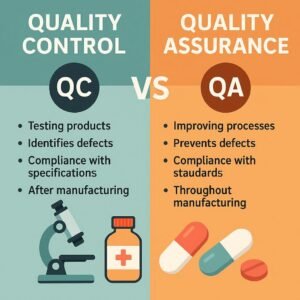
Quality Control (QC) is a product-focused and reactive approach that involves inspecting, testing, and measuring finished products to identify and correct defects after production. In contrast, Quality Assurance (QA) is a process-focused and proactive approach that aims to prevent defects by developing and implementing quality standards throughout the entire product lifecycle. In essence, QA builds […]
Read MoreThe MACO calculation, or the Maximum Allowable Carryover calculation in pharmaceutical manufacturing, determines the maximum residue from a previous product that can remain on shared equipment without risking contamination or harm to the next product or patient. It is essential for cleaning validation to ensure effective cleaning and prevent cross-contamination. FAQs on MACO Calculation […]
Read MoreControl Samples Or Retention Samples or Reference Samples are reference materials with known properties used to verify the accuracy and reliability of tests, serving as benchmarks to ensure consistent, acceptable results. These samples play a critical role in post-market surveillance, regulatory compliance, and the investigation of complaints. In this article, I will discuss the definition, […]
Read MoreProcess validation and product validation are distinct yet complementary activities essential to ensuring quality in pharmaceutical manufacturing. Process validation confirms that the manufacturing process consistently yields products meeting predefined specifications, while product validation verifies that the final product meets its intended use and quality requirements. In pharmaceutical development, both the drug and its manufacturing process […]
Read More9+ Top Pharma Quality Control (QC) Interview Questions and Answers
Read MoreHow to Read a Chromatogram is one of the fundamental skills to proceed with the HPLC and GC analysis. A chromatogram is interpreted by analysing the axes, identifying the peaks, and evaluating their characteristics such as Retention Time, Peak Shape, Peak Height and Area. In this article, I will explain how to read and interpret chromatograms, […]
Read MoreLearn about process validation in the pharmaceutical industry, its principles, types, and key case studies. Understand its importance for ensuring product quality, regulatory compliance, and patient safety.
Read MoreThe key difference between GMP and cGMP is that GMP (Good Manufacturing Practices) refers to established guidelines for manufacturing quality products, while cGMP (current Good Manufacturing Practices) emphasises the ongoing implementation of up-to-date technologies, practices, and regulations to ensure product quality and compliance with evolving industry standards. In this blog, I will discuss the key […]
Read MoreLearn DQ, IQ, OQ, And PQ: Concept with applications, case studies and FAQs
Read MoreLearn the key difference between validation and qualification in pharmaceutical manufacturing and why both are essential for GMP compliance and product quality.
Read MoreLearn what Is limit test and why It Is important in pharmaceutical analysis with FAQs
Read MoreLearn about monographs and standard testing procedures (STP), key differences, writing process, and benefits with FAQs.
Read MoreLearn about Pharmaceuticals Certificate of Analysis its content, preparation and approval with FAQS
Read MoreThere is no excerpt because this is a protected post.
Read More
HPLC (High-Performance Liquid Chromatography) is a chromatographic technique that employs a solid stationary phase and a liquid mobile phase to efficiently separate, identify, and quantify components within a sample or complex mixture The term “chromatography” refers to the general process of separation, while a “chromatograph” is the instrument used, and a “chromatogram” is the visual […]
Read MoreSulphated Ash Test In Pharmaceutical Analysis: Why, How, And At What level , procedure, calculation, case studies and FAqs
Read MoreLearn about Loss on Drying test, purpose, procedure, acceptable limits , case studies and FAQs
Read MoreLearn how Headspace Gas Chromatography improves pharmaceutical quality by managing OVIs. Includes GC-HS principles, method development, applications, advantages, and FAQs
Read Moreppm, mcg and percentage are the units of measurement and play a crucial role in pharmaceutical development. In both synthetic and analytical chemistry, precise measurements are key to accurate sample preparation and analysis. Among the most frequently used units in this process are ppm, mcg/µg, and % – terms that, while common, often lead to […]
Read MoreLearn the essentials of peak integration in chromatographic analysis, including integration types, common errors, influencing factors, and practical tips to avoid mistakes.
Read More
Learn the importance of assay in pharmaceutical development. Discover how assays ensure drug quality, safety, and efficacy, and explore the steps and precautions involved in performing them
Read More
Learn CSV (computer system validation) with our 12-step ultimate guide to enhance efficiency in pharmaceutical data management.
Read More
Explore Karl Fischer coulometric titration for precise water measurement at a very low level in drug development processes. Essential for pharma success.
Read MoreQuick Links