Description
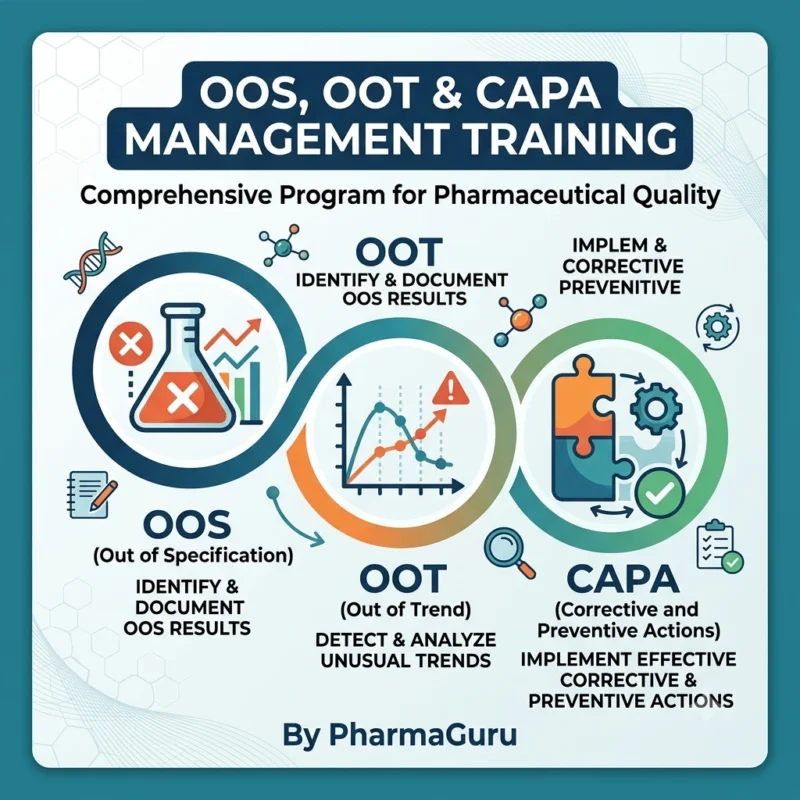
OOS, OOT & CAPA Management Training for ARD/QC/QA/RA Professionals | Popular course
Course Description
This six-day popular course provides a structured and practical understanding of Out of Specification (OOS), Out of Trend (OOT), and Corrective and Preventive Action (CAPA) management in the pharmaceutical industry. The program focuses on laboratory investigations, deviation management, root cause analysis, risk assessment, GMP-compliant documentation, and continuous quality improvement.
Participants will learn how to identify, assess, investigate, document, and resolve OOS/OOT events using a systematic, scientifically justified, and risk-based approach. The course also covers CAPA lifecycle management, effectiveness verification, data integrity principles, and integration with pharmaceutical Quality Management Systems (QMS).
Regulatory and quality system expectations from FDA, EMA, WHO, ICH Q10, and applicable GMP requirements will be discussed. Through practical exercises, investigation scenarios, case studies, and documentation workshops, participants will develop foundational skills for handling quality events and supporting inspection readiness.
Six-Day Course Module
Day 1: Fundamentals of Pharmaceutical Quality Systems, GMP, OOS, OOT and CAPA
Module 1: Introduction to Pharmaceutical Quality Management
- Fundamentals of pharmaceutical Quality Management Systems (QMS).
- Principles of Good Manufacturing Practices (GMP).
- Roles and responsibilities of QC, QA, manufacturing, and other quality functions.
- Introduction to deviations, non-conformities, complaints, and quality events.
Module 2: Understanding OOS and OOT
- Definition and significance of Out of Specification (OOS) results.
- Definition and significance of Out of Trend (OOT) results.
- Differences between OOS, OOT, atypical results, and deviations.
- Common causes of OOS/OOT in pharmaceutical laboratories and manufacturing.
- Impact of OOS/OOT on product quality, patient safety, and regulatory compliance.
Module 3: Introduction to CAPA
- Definition and importance of Corrective and Preventive Action.
- Differences between correction, corrective action, and preventive action.
- CAPA as a component of pharmaceutical QMS.
- Relationship between OOS/OOT, deviations, investigations, and CAPA.
Practical Activity: Classification of pharmaceutical quality events into OOS, OOT, deviation, and CAPA scenarios.
Day 2: OOS Investigation Process and Laboratory Investigation Techniques
Module 1: OOS Investigation Fundamentals
- When and how to initiate an OOS investigation.
- Initial assessment and laboratory investigation stages.
- Review of analytical worksheets, raw data, calculations, and chromatograms.
- Assessment of analyst practices, sample preparation, reagents, and standards.
- Review of instrument performance and system suitability.
Module 2: Laboratory Investigation
- Checking analytical methods and test procedures.
- Evaluating instrument calibration, maintenance, and performance.
- Investigating potential laboratory errors and assignable causes.
- Scientific evaluation of laboratory findings.
- Hypothesis testing and additional testing considerations.
- Handling invalid test results and repeat testing in accordance with approved procedures.
Module 3: Full-Scale Investigation and Documentation
- When an investigation should extend beyond the laboratory.
- Assessment of manufacturing records, raw materials, and process parameters.
- Impact assessment for batches, products, and related quality events.
- Investigation timelines, escalation, and communication.
- Documentation and quality approval requirements.
Practical Activity: Mock OOS investigation involving an assay failure, including initial assessment, laboratory checks, evidence review, and investigation documentation.
Day 3: OOT Investigation, Trend Analysis, Data Integrity and Root Cause Analysis
Module 1: OOT Identification and Trend Monitoring
- Identification of atypical results and emerging trends.
- Difference between specification limits and trend limits.
- Review of historical analytical data.
- Trending of assay, dissolution, impurities, stability, and other quality attributes.
- Introduction to basic statistical tools, control charts, and trend evaluation.
- Detecting potential method drift, process variability, and material-related issues.
Module 2: Data Integrity and GMP Documentation
- ALCOA+ principles and their application to laboratory records.
- Complete, accurate, consistent, and traceable documentation.
- Handling original data, audit trails, electronic records, and corrections.
- Good documentation practices during investigations.
- Common data integrity deficiencies and prevention strategies.
Module 3: Root Cause Analysis (RCA)
- Importance of identifying the true root cause.
- Difference between symptoms, contributing factors, and root causes.
- Five Whys technique.
- Fishbone (Ishikawa) diagram.
- Introduction to fault-tree analysis and other investigation tools.
- Human error, procedural gaps, equipment issues, and method-related causes.
- Avoiding assumptions and unsupported root cause conclusions.
Practical Activity: Analyze a laboratory OOT trend and construct a Fishbone diagram and Five Whys analysis for a recurring analytical failure.
Day 4: CAPA Lifecycle, Risk Assessment and Corrective/Preventive Action Planning
Module 1: CAPA Initiation and Evaluation
- Sources of CAPA: OOS/OOT, deviations, complaints, audits, and recurring failures.
- CAPA initiation criteria and prioritization.
- Risk assessment based on severity, occurrence, and detectability where appropriate.
- Product quality, patient safety, and compliance impact assessment.
- Linking investigation conclusions to CAPA requirements.
Module 2: CAPA Development and Action Planning
- Developing scientifically justified corrective actions.
- Establishing preventive measures to reduce recurrence.
- Distinguishing immediate corrections from systemic corrective actions.
- Assigning responsibilities, timelines, and resources.
- Defining measurable acceptance criteria and completion evidence.
- Evaluating action feasibility and potential unintended consequences.
Module 3: CAPA Implementation and Change Control
- CAPA action tracking and implementation.
- Relationship between CAPA and change control.
- Updating SOPs, methods, training, equipment controls, and monitoring plans.
- Documenting action completion and approvals.
- Handling overdue CAPAs, extensions, and escalations.
Practical Activity: Develop a CAPA plan for a recurring dissolution failure or an analytical instrument-related investigation, including root cause, risk assessment, actions, owners, and timelines.
Day 5: CAPA Effectiveness Verification, Regulatory Compliance and Quality System Integration
Module 1: CAPA Effectiveness Verification
- Difference between action completion and demonstrated effectiveness.
- Establishing objective and measurable effectiveness criteria.
- Selecting suitable monitoring periods and sample sizes based on risk.
- Reviewing recurrence, trends, deviations, and related quality metrics.
- CAPA closure requirements.
- Handling ineffective CAPAs, re-opening investigations, and additional actions.
Module 2: Regulatory Expectations and Inspection Readiness
- FDA expectations for OOS investigations and pharmaceutical quality systems.
- Overview of applicable EMA and WHO GMP expectations.
- Introduction to ICH Q10 pharmaceutical quality systems.
- Relevant GMP requirements for investigation, documentation, and CAPA.
- Inspection observations associated with inadequate investigations.
- Common deficiencies in OOS/OOT investigations and CAPA implementation.
Module 3: Integration with Pharmaceutical Quality Systems
- CAPA and deviation management.
- CAPA and complaint handling.
- CAPA and internal audits.
- CAPA and change control.
- Management review and quality metrics.
- Continuous improvement and knowledge management.
Practical Activity: Evaluate a completed CAPA record, identify documentation and effectiveness gaps, and determine whether the CAPA is ready for closure.
Day 6: Integrated Case Studies, Documentation Workshop and Final Assessment
Module 1: Integrated OOS/OOT Investigation
- Review of an OOS analytical result and associated laboratory records.
- Assessment of potential laboratory and manufacturing causes.
- Evaluation of data integrity and product impact.
- Root cause determination and investigation conclusions.
- Development of appropriate corrective and preventive actions.
Module 2: CAPA Documentation Workshop
- Preparation of an investigation report.
- Completion of a CAPA form and action plan.
- Documentation of root cause analysis and risk assessment.
- Defining effectiveness criteria and closure requirements.
- Ensuring traceability, consistency, and GMP-compliant documentation.
Module 3: Common Investigation Failures and Best Practices
- Inadequate root cause analysis.
- Repeated testing without scientific justification.
- Unsupported invalidation of results.
- Generic corrective actions and ineffective preventive measures.
- Incomplete documentation and weak effectiveness checks.
- Lessons learned and sustainable quality improvement.
Module 4: Assessment and Course Conclusion
- Knowledge assessment and case-based questions.
- Review of key OOS, OOT, RCA, and CAPA concepts.
- Discussion of practical workplace applications.
- Guidance for continued learning in pharmaceutical QC/QA and quality systems.
Final Practical Assessment: Complete an integrated OOS/OOT investigation and CAPA exercise from initial event identification through investigation, root cause analysis, action planning, and effectiveness verification.
Key Learning Outcomes
By the end of the six-day course, participants will be able to:
- Explain OOS, OOT, CAPA, deviation management, and their roles in pharmaceutical QMS.
- Describe the stages of a scientifically justified OOS/OOT investigation.
- Evaluate laboratory data, analytical methods, instruments, and system suitability.
- Apply basic trend analysis and root cause investigation tools.
- Demonstrate awareness of ALCOA+ data integrity and GMP documentation practices.
- Develop risk-based corrective and preventive action plans.
- Define measurable CAPA effectiveness criteria and closure requirements.
- Understand relevant FDA, EMA, WHO, ICH Q10, and GMP expectations.
- Explain the integration of CAPA with deviations, complaints, audits, and change control.
- Apply foundational investigation and CAPA skills to practical pharmaceutical quality scenarios.
Training Methodology
- Instructor-led presentations and interactive discussions.
- Practical pharmaceutical case studies.
- Mock OOS/OOT investigation exercises.
- Root cause analysis using Five Whys and Fishbone diagrams.
- CAPA planning and documentation workshops.
- Knowledge assessments and a final case-based exercise.
Target Audience:
Target Audience: Students | Freshers | Career Switchers | Early-Career Professionals | Professionals in Analytical, QC, QA, RA, and R&D
Course Outcome
Participants will gain foundational knowledge of OOS/OOT investigations, CAPA management, root cause analysis, GMP compliance, and pharmaceutical quality systems. They will develop greater confidence in understanding investigation workflows, evaluating quality events, preparing investigation documentation, and planning effective corrective and preventive actions.
Important note: This is a foundation-level training program. It supports professional development but does not, by itself, qualify participants as independent investigators or establish regulatory compliance competence. Practical application should follow the employer’s approved procedures, applicable regulations, and appropriate supervision.
Sessions: 6 sessions (≥9 hours / ≥540 minutes)
Mode of Training: Online (via Google Meet)
Certificate: Yes, certificate of completion will be provided
Money-Back Guarantee: 30-day money-back guarantee
Language: English
Instructor: Dr. Pramod Kumar Pandey (PhD in Chemistry) 31+ years of experience in global and Indian pharmaceutical industries



Reviews
There are no reviews yet.