Description
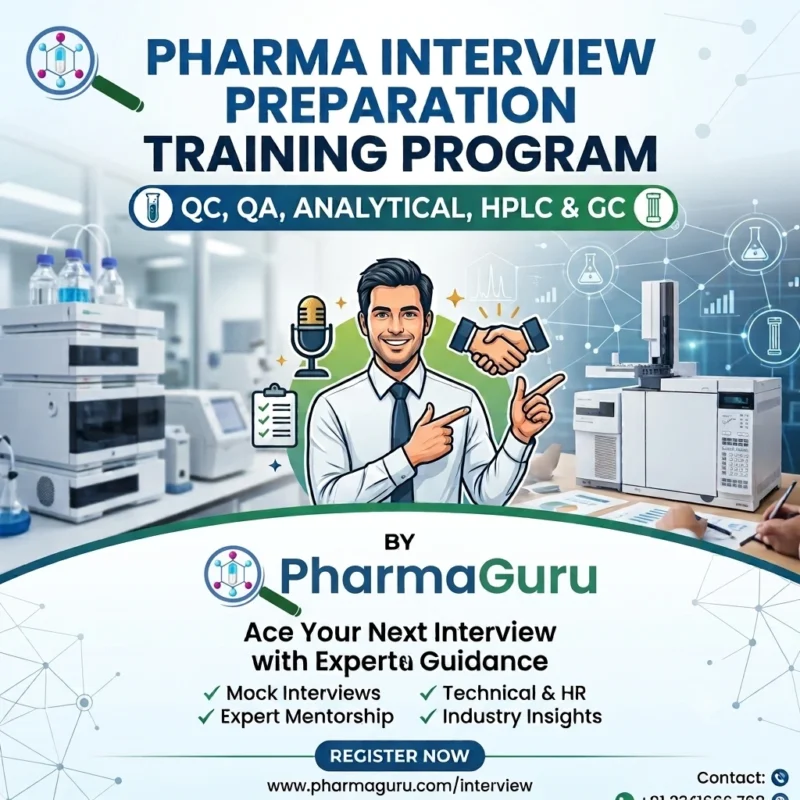
Program overview
10 Days of Intensive Training
- Suggested duration: 1–2 hours per day
- Training format
- Practical + Interactive
- Target audience
- Freshers & Experienced
- Career focus
- QC, QA & Analytical
- Final assessment
- Mock Interview
Detailed 10-day training module
Interview Strategy, CV & LinkedIn Profile Development
Understanding the pharmaceutical job market and job descriptions.
Building a targeted CV/resume for QC, QA, and Analytical roles.
Creating an ATS-friendly resume with relevant technical keywords.
Optimizing LinkedIn headlines, About section, skills, and experience.
Job-search strategies, recruiter outreach, and professional networking.
Understanding common interview rounds and preparing a personal action plan.
Practical activity: Prepare a role-specific CV and optimize a LinkedIn profile.
Self-Introduction, Confidence & Professional Communication
How to introduce yourself in 60–90 seconds.
How to explain education, experience, strengths, and career goals.
Handling questions about gaps, job changes, weaknesses, and salary expectations.
Professional etiquette, body language, eye contact, and voice modulation.
Building confidence through structured practice and feedback.
Managing interview anxiety and difficult questions.
Practical activity: Record and evaluate a self-introduction; participate in peer interviews.
HR Questions, IQ Tests & General Aptitude
Frequently asked HR interview questions and effective answer structures.
Logical reasoning, number series, patterns, and analytical thinking.
Numerical aptitude, percentages, ratios, averages, and basic calculations.
Attention-to-detail tests and data interpretation.
Pharmaceutical general awareness and basic scientific reasoning.
Situational judgment, teamwork and problem-solving questions.
Practical activity: Timed aptitude test followed by an HR question-and-answer session.
Pharmaceutical Industry Fundamentals: QC, QA & GMP
Roles and responsibilities of QC, QA, and Analytical departments.
GMP, GLP, GDP (Good Documentation Practices), and data integrity.
SOPs, specifications, STPs, protocols, and laboratory records.
Deviations, OOS, OOT, CAPA, change control, and investigations.
Calibration, qualification, validation, and documentation.
Common technical questions for pharmaceutical interviews.
Practical activity: Solve a documentation error case and explain an OOS investigation approach.
HPLC & Advanced Liquid Chromatography
HPLC principle, instrumentation, and working mechanism.
Pumps, injector, column, detector, and data system.
Mobile phase preparation, filtration, degassing, and sample preparation.
Isocratic versus gradient elution; normal-phase versus reversed-phase chromatography.
System suitability, retention time, resolution, tailing factor, and theoretical plates.
Calibration, validation basics, and troubleshooting common chromatographic problems.
Introduction to LC-MS/MS and its pharmaceutical applications.
Practical activity: Interpret a chromatogram and troubleshoot peak tailing, pressure changes and poor resolution.
GC, GC-MS & Instrumental Troubleshooting
Gas chromatography principle, instrumentation, and applications.
Carrier gases, columns, injectors, detectors, and oven temperature programming.
GC method parameters and system suitability.
GC-MS principle, mass spectra, and compound identification basics.
Residual solvent testing and sample preparation concepts.
Common errors: baseline noise, ghost peaks, leaks, and poor peak shape.
Frequently asked GC, GC-MS, and mass spectrometry interview questions.
Practical activity: Interpret a GC chromatogram and work through a residual-solvent case study.
Titration, UV-Visible Spectroscopy & FTIR
Volumetric analysis: acid-base, redox, and complexometric titrations.
Primary standards, standardization, indicators, and endpoint detection.
Calculation of concentration, normality, molarity, and assay.
UV-Visible spectroscopy: Beer–Lambert law, wavelength selection, and calibration.
FTIR principle, functional groups, and spectral interpretation.
Instrument calibration, handling errors, and routine troubleshooting.
Common analytical chemistry interview questions.
Practical activity: Solve assay and titration calculations; interpret basic UV and FTIR results.
Advanced QC, QA & Real-World Case Studies
OOS and OOT investigations: initial assessment and root-cause analysis.
Deviations, CAPA effectiveness, and change-control scenarios.
Data integrity, ALCOA+ principles, and audit-trail review.
Method validation and verification: accuracy, precision, specificity, linearity, range, LOD and LOQ.
Stability studies, analytical method transfer, and laboratory controls.
Handling failed system suitability, atypical results, and documentation discrepancies.
Risk-based thinking and explaining investigation decisions in interviews.
Practical activity: Group case study on an unexpected assay result and a documentation discrepancy.
Your First 30 Days in QC, QA or Analytical
Understanding departmental responsibilities, reporting structures, and KPIs.
Laboratory safety, gowning, housekeeping, and good documentation habits.
SOP training, instrument logbooks, sample receipt, and workflow.
Working under supervision and knowing when to escalate an issue.
Handling workload, urgent samples, deadlines, and conflicting priorities.
Stress management, teamwork, conflict resolution, and professional conduct.
How experienced candidates can explain achievements and technical problem-solving.
Practical activity: Simulate a first-day laboratory briefing and a pressure-handling scenario.
Mock Interviews, Final Assessment & Job-Readiness Plan
Full HR mock interview.
Technical mock interview based on the selected department.
Rapid-fire QC, QA, HPLC, GC, and analytical chemistry questions.
Aptitude and attention-to-detail assessment.
Case-study presentation and problem-solving evaluation.
Feedback on CV, self-introduction, confidence, and communication.
Personalized improvement plan and job-application strategy.
Practical activity: Final interview simulation, performance review, and individual feedback.
Reviews
There are no reviews yet.