Dr. Pramod Kumar Pandey — Pharmaceutical Trainer, Founder of PharmaGuru, Blogger & Analytical Expert with 31+ years of experience in leading global and Indian pharmaceutical companies.
Thin-Layer Chromatography or TLC is a separation technique based on the solid stationary phase (coated on the plate) and the liquid mobile phase. Separation is governed by the polarity principle – “Like Attracts Like”
TLC (Thin-Layer Chromatography) | Easy Learning With Case Study & FAQs
TLC (Thin Layer Chromatography) is widely used for qualitative analysis, such as monitoring the reactions , purity test, identifying test and controlling the impurities during pharmaceutical development. It is a fast, and cost-effective analytical technique.
In this article, you will learn principle, key applications, advantages, limitations, method development strategies, case studies with FAQs. By the end, your doubts will be cleared, and your knowledge of TLC will reach the next level.
What Is Thin-Layer Chromatography (TLC)?
Thin-Layer Chromatography or TLC is a separation technique based on the solid stationary phase (coated on the plate) and the liquid mobile phase. Separation is governed by the polarity principle – “Like Attracts Like”. In other words, separation depends upon the polarity of each analyte, the stationary phase and the mobile phase. It comes under complete chromatography.
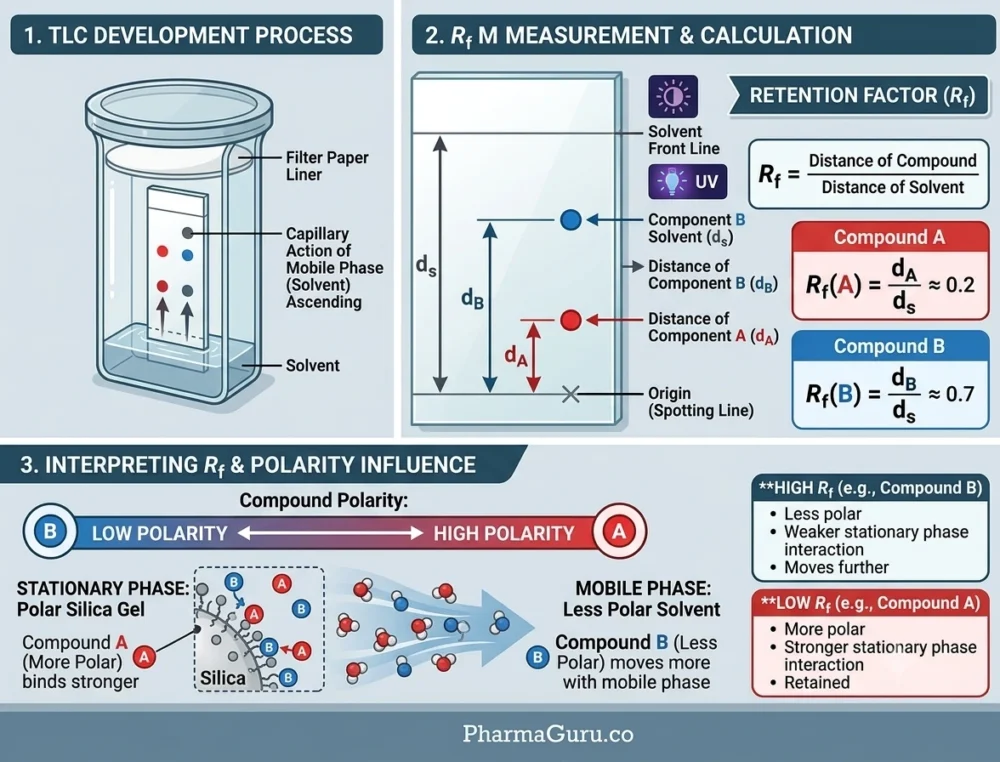
A spot of the sample mixture is made on the TLC plate using a syringe or capillary tube, and the plate is placed in the TLC chamber containing the mobile phase. The mobile phase is moved over the TLC plate. Each Analyte of the sample mixture interacts with the mobile phase as well as with the stationary phase. During interaction, the stationary phase wants to retain the analyte, whereas the mobile phase wants to carry the analyte with it. The more polar compound retains more on the stationary phase (on the TLC plate) and moves slowly on the TLC plate compared to the nonpolar or less polar compound. Due to the difference in polarity, each compound interacts with the stationary phase and the mobile phase with different capacities, and they separate. The relative mobility of the compound is described by the Rf or Retention factor value.
Rf value or Retention factor value
Rf = Distance of the migration of the compound /Distance moved by the mobile phase
TLC (Thin-Layer Chromatography) | Easy Learning With Case Study & FAQs 4
It is the ratio of the distance covered by the compound to the distance covered by the solvent (mobile phase).Rf value is unique for each compound under specific conditions, such as the stationary phase, temperature, thickness of the adsorbent layer, amount of the spotted material and the mobile phase used
Expert Tip: The Rf value is a decimal fraction, generally only reported to two decimal places
7 Important Components of The Thin Layer Chromatograph
The following are the different components of the TLC:
Thin Layer Chromatography Plates
Thin Layer Chromatography (TLC) Mobile phase
Thin Layer Chromatography (TLC) modifiers
Thin Layer Chromatography (TLC) chamber
Filter paper
Thin Layer Chromatography (TLC) syringe
Thin Layer Chromatography (TLC) UV chamber
Thin-Layer Chromatography Plates
Commercial TLC plates are made of Aluminium and coated with a stationary phase like Silica gel or Aluminium oxide. A TLC plate can also be made using a glass plate or a plastic plate
1. Thin Layer Chromatography (TLC) Mobile phase
A solvent or a mixture of solvents with different polarities is used as the mobile phase. Generally, Hexane, heptane, chloroform, dichloromethane, ethyl acetate, ethanol, and isopropyl alcohol are used as solvents in the mobile phase. Acetic modifiers like formic acid, acetic acid and basic modifiers like ammonia, triethyl amine and diethyl amine are also used in the mobile phases based on the polarity of the analyte.
2. Thin Layer Chromatography (TLC) modifiers
: Acidic modifiers like formic acid, acetic acid and basic modifiers like ammonia, triethyl amine and diethyl amine are also used in the mobile phases based on the polarity of the analyte.
3. Thin Layer Chromatography (TLC) chamber
The TLC chamber is made of glass and it is used to develop the TLC plate. This maintains a stable environment during analyte spot development in the TLC process. It also prevents solvent evaporation and keeps the entire process dust-free.
5. Filter paper
It is used to equilibrate the TLC chamber.
6. Thin Layer Chromatography (TLC) syringe
It is required to apply the sample/standard spot on the TLC plate
7. Thin Layer Chromatography (TLC) UV chamber
It is required to detect the analyte spot
Colour development reagent: Reagents like Iodine vapour, Ninhydrin solution, KMnO4 solution and alkaline tetrazolium blue solutions are used for colour development
Thin Layer Chromatograph solvents | How to Select?
TLC can be operated in Normal phase chromatographic mode (NPC) and Reverse phase chromatographic mode (RPC). But it is widely used in NPC mode. The following solvents are widely used:
Non-Polar Solvents (Hydrophobic)
Hexane (n-Hexane): Often used for non-polar compounds. It is commonly mixed with more polar solvents to adjust polarity.
Petroleum Ether: A mixture of hydrocarbons, often used for non-polar to moderately polar compounds.
Toluene: Slightly more polar than hexane and often used for moderately non-polar compounds.
Diethyl Ether: A low-polarity solvent, often used in mixtures with hexane or other solvents.
Polar Solvents (Hydrophilic)
Ethyl Acetate: A relatively polar solvent used for moderately polar compounds, often in mixtures with non-polar solvents.
Acetone: Polar, good for separating compounds with moderate polarity.
Chloroform (CHCl₃): A moderately polar solvent, useful for separating a range of organic compounds.
Methanol (MeOH): Very polar, often used for highly polar compounds. Methanol is also commonly mixed with other solvents like chloroform, ethyl acetate, or water.
Water: Used in aqueous-based separations, often in combination with organic solvents.
Mixed Solvent Systems
Hexane / Ethyl Acetate: A common mixture, where the ratio of hexane to ethyl acetate is adjusted based on the polarity of the compounds being separated. For example, a 9:1 mixture of hexane to ethyl acetate for non-polar compounds or a 1:1 mixture for more polar compounds.
Chloroform / Methanol: Often used for polar compounds, with varying ratios depending on the polarity of the analytes.
Hexane / Acetone: A mixture used for compounds with intermediate polarity, often in ratios like 7:3 or 9:1.
Other Common Solvents or Mixtures
Dichloromethane (DCM): A moderately polar solvent, useful for a variety of organic compounds.
Hexane / Toluene: Used for non-polar to slightly polar compounds.
Acetonitrile (MeCN): A polar aprotic solvent, often used in gradient elution or in mixtures with other solvents.
Thin Layer Chromatography (TLC) Procedure
The following steps are involved in the TLC process;
Make the point of spot application using a pencil. Keep in mind, TLC spots should be evenly spaced and should not sink into the mobile phase.
Apply the sample to the marked spots TLC plate using a syringe or a capillary
Transfer the mobile phase to the TLC chamber
Place the moistened (with mobile) filter paper along the inside wall of the TLC chamber. It maintains equal humidity and prevents the edge effect.
Insert the prepared TLC plate into the chamber with the sample spot facing the mobile phase.
Close the chamber and allow sufficient time (about 40 to 60 minutes) to separate each analyte spot during TLC development
Remove the TLC plate from the chamber and allow it to dry
Analysed the spot using UV light or by colour development (using KMnO4 or Iodine vapour)
Calculate the Rf value
How to develop the Thin-Layer Chromatography Method?
In TLC, separation is governed by polarity. The mobile phase is selected based on the polarity of each analyte in the sample mixture. For polar molecules polar mobile phase is used, and for nonpolar molecules, non polar mobile phase is used. The following steps play an important role in TLC method development:
Selection of the stationary phase
Selection of the Mobile phase and
Mobile phase optimisation
Selection of the stationary phase
Silica and Alumina are commonly used as the stationary phase in TLC. Therefore, the scope to play with the stationary phase during TLC development is limited.
Selection of the Mobile phase
The mobile phase is designed based on the polarity of each analyte in the sample mixture. Use
Polar mobile phase for polar molecules
Nonpolar mobile phase for nonpolar molecules
Modifiers in the mobile phase to control the polarity
Generally, Hexane, heptane, chloroform, dichloromethane, ethyl acetate, ethanol, and isopropyl alcohol are used as the mobile phase. Acidic modifiers like formic acid, acetic acid, trifluoroacetic acid and basic modifiers like ammonia, triethyl amine and diethyl amine are added in the mobile phase based on the polarity of the analyte in the sample mixture.
Mobile phase optimisation
The composition of the solvent in the mobile phase is varied to get better separation between the spots.
Increase the polar solvent (like ethanol, Isopropyl alcohol and Ethyl acetate) ratio to reduce/control the separation
Decrease the polar solvent (like ethanol, Isopropyl alcohol and Ethyl acetate) ratio to increase the separation
How Is Thin-Layer Chromatography Useful for Quick Drug Identification And Reaction Monitoring?
TLC is useful for quick drug identification and reaction monitoring because it provides fast, simple, and cost-effective separation of components. By comparing the Rf values and spot patterns of a sample with reference standards, drugs can be identified within minutes. During chemical reactions, TLC helps track the conversion of reactants to products by showing the appearance or disappearance of spots, allowing rapid assessment of reaction progress. Its speed, minimal sample preparation, and ease of visualisation make TLC ideal for routine pharmaceutical analysis.
Case study-1: Separation of N-(4-hydroxyphenyl)acetamide and 4-aminophenol by TLC
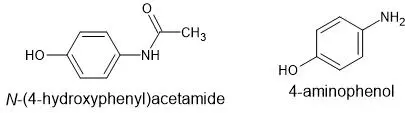
The following are the structures of Acetaminophen and 4-aminophenol:
Figure-1
From the above structure, it is clear that both compounds are polar, but 4-aminophenol is more polar compared to N-(4-hydroxyphenyl)acetamide.
Selection of TLC stationary phase: A TLC plate containing Silica gel coating can be used
Selection of mobile phase: Both 4-aminophenols are more polar compared to N-(4-hydroxyphenyl)acetamide, are contains -NH and -OH functional groups. Hence polar mobile phase with a basic modifier will be a suitable choice. For example, a mixture of Hexane/Heptane (non-polar) and Isopropyl alcohol/Ethanol (polar) with a basic modifier like Triethyl amine/ammonia solution can be used
Mobile phase optimisation: Increase the ratio of nonpolar solvent and reduce the modfier to get better separation between the spots
Final TLC condition: In the following TLC mobile phase condition, each spot of N-(4-hydroxyphenyl)acetamide and 4-aminophenol is well separated.
Final mobile phase: Hexane: Isopropyl alcohol: Triethylamine (90:10:0.05)
Case study 2: How to develop a TLC method for quantification of Tetrabutylammonium fluoride?
Method development approach:
Molecular weight: C16H36FN
Molecular weight: 261.46g/mol
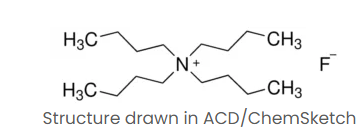
Following is the structure of Tetrabutylammonium fluoride
TLC (Thin-Layer Chromatography) | Easy Learning With Case Study & FAQs 5
From the structure, it is clear that it is a quaternary ammonium salt. It does not have any chromophore, and secondly, it is an ionic compound. Therefore, it will neither be analysed on HPLC nor on GC.
The only possibility is to develop a qualitative TLC method. That is why widely qualitative TLC method is widely used for its content in Pharmaceutical substances.
In the following TLC condition, it is quantified up to 0.05% in the pharmaceuticals
TLC condition
TLC plate: Silica Gel 60 F254
TLC mobile phase: mixture of Dichloromethane and Methanol in the rat io of 88:12.
TLC chamber: Vertical chamber saturated with 25% ammonium hydroxide solution
Diluent: Dichloromethane
Sample concentration: about 150mg/ml in Dichloromethane
Standard: Tetrabutylammonium fluoride 0.05% ( weigh about 7.5 mg of Tetrabutylammonium fluoride and dilute to 100 ml with diluent)
Injection volume: 5µl
Run: about 10 cm
Detection: iodine vapour about 25 to 30 minutes
TLC Procedure
Apply 5 µL of each standard and sample solution to the TLC plate and allow the spots to dry. Place the TLC plate in the equilibrated TLC chamber. Run the mobile phase up to 10 cm on the plate. Allow the plate to dry at room temperature in the hood. Then, put the TLC plate in the iodine chamber for 25 to 30 minutes. Compare the spot of Tetrabutylammonium fluoride in the sample with the standard Tetrabutylammonium fluoride.
TLC Troubleshooting
The following type of problem occurs during TLC analysis:
Tailing in the analyte spot: If this problem occurs in the routine method, then there is an equilibration issue. Equilibrate the TLC system properly, and then this tailing issue will be resolved
The analyte spot is not moving from the point of application. If this type of problem occurs in the regular method, then there is a problem of solvent evaporation from the mobile phase. Prepare the fresh mobile phase, equilibrate the TLC system properly and then this issue will be resolved
Analyte does not retain on the TLC plate and moves with the mobile phase: If this type of problem occurs in the routine method, then there is a problem of mobile phase preparation. Prepare the fresh mobile phase, equilibrate the TLC system properly and then this issue will be resolved
Distortion of the analyte’s spot: If this type of problem occurs in the routine method, then there is a problem in the mobile phase and the temperature of the lab. Prepare the fresh mobile phase, equilibrate the TLC system properly in temperature temperature-controlled environment and then this issue will be resolved
Advantages
The following are the TLC advantages:
Selective technique with high separation power: Generally, normal phase TLC are used in the industries, and it is highly selective for qualitative analysis, like identification tests and purity tests.
Simple technique: It is a simple technique and does not need any special skill. Anyone can perform the TLC .
Inexpensive technique: It is cost cost-effective analytical technique. That is the reason TLC is backbone of every industry
Quick analysis: TLC is known for its fast results. One can get a result within 10 to 40 minutes. That is why it is widely used in the monitoring of the reaction.
Versatile technique: It is a versatile technique and can be used for various types of compounds, such as organic and inorganic compounds. For example content of Triethylamine and tetrabutyl ammonium bromide content in pharmaceuticals is performed by TLC
High sensitivity: It is high sensitive instrument for qualitative analysis, like identification and purity test
Sample recovery: The Sample can easily be recovered after TLC analysis since volatile solvents are used in the TLC
Visualisation: Analyte spots can easily be seen in the UV chamber or by colour development
Scale-up potential: The TLC technique can be used for scale-up after certain modifications
Regulatory acceptance: The TLC technique is acceptable by all regulatory agencies in the world
Disadvantages
The following are the disadvantages of the TLC technique
Quantitative analysis: Less suitable for quantitative analysis
Detection limit or sensitivity: Sensitivity of the TLC is less than the other chromatographic techniques like HPLC/UPLC and GC
Separation power: Limited stationary phases are available for the TLC and hence one can play only with the mobile phase during TLC development. That is the reason TLC has limited separation power.
What are the new advancements in TLC?
TLC can also be performed in reverse phase chromatography mode (RPTLC). Now several new TLC plates containing C18 and C8 stationary phases are commercially available in the market.
TLC is also used for Chiral purity using the chiral stationary phase.
RP-TLC stationary phase selection
TLC plates containing C18 and C8 stationary phases are used
RP-TLC stationary phase selection
Mixture of water and less polar organic solvents like tetrahydrofuran, methanol, ethanol, Isopropyl alcohol and acetonitrile are used.
Order of elution: Non polar analyte retin more compared to polar analyte
Advantages of RP-TLC
Humidity does affect the result since mixture of aqueous and organic solvents are used
Separation of analyte of different polarities such as nonpolar, less polar and extremely high polar can be possible
RP-TLC results can be directly correlated with HPLC or UPLC
Wide range of mobile phase selection availability and hence one can play a lot during mobile phase optimisation
Thin Layer Chromatography (TLC) Applications
TLC is widely used for monitoring the reaction, identification test, purity test, related substances test, impurity profile test, compound purification, pesticide residue test, genotoxic impurity test and content test in the following industries:
Despite some limitations, TLC is widely used for various tests like mentoring the reaction, identifications, purity, related substances in the pharmaceutical industries due to its reliability of the result, simplicity and cost effectiveness. Now I hope this post has cleared all your doubts related to TLC and you can apply it more effectively in pharmaceutical development. For any queries or suggestion related to this article write in the comment section or contact me using contact form.
Thin layer chromatography is the separation technique to separate the analytes from the sample mixture. It contains TLC plate coated with the stationary phase and liquid mobile phase. Separation occurs due to interaction of the analyte with the stationary phase and the mobile phase which is governed by polarity
What is the principle of Thin layer chromatography or TLC?
TLC contains the solid stationary phase (coated on the plate) and the liquid mobile phase. Separation is governed by the polarity principle.
What is the thin layer chromatography used to separate?
TLC is used to separates compound from the sample mixture. It may be westside in cosmetic sample or genotoxic impurities in the pharmaceuticals.
What are the advantages of the thin layer chromatography?’
TLC is fast, simple and cost effective technique
How thin layer chromatography is more superior than other chromatographic methods?
Due to quick result, costeffetiveness and simplicity it is more superior than other chromatography like HPLC and UPLC
How do you perform thin layer chromatography?
Prepare the sample and a make sample-spot on the TLC plate. Develop the TLC in the TLC chamber and visualize the spot in UV chamber or by colour development
Can TLC be used for quantitative analysis?
Can be used but result will not be reproducible. TLC is mainly used for qualitative analysis
How long does it take to perform a TLC analysis?
TLC is a fast analysis band can be completed within an hour
Can TLC be used for analysing volatile compounds?
Not in all cases. But some of the volatile compounds like triethylamine is analyzed by TLC