

Learn Thermogravimetric Analysis (TGA) in drug development with simple explanations, key principles, applications, FAQs, and real case studies.
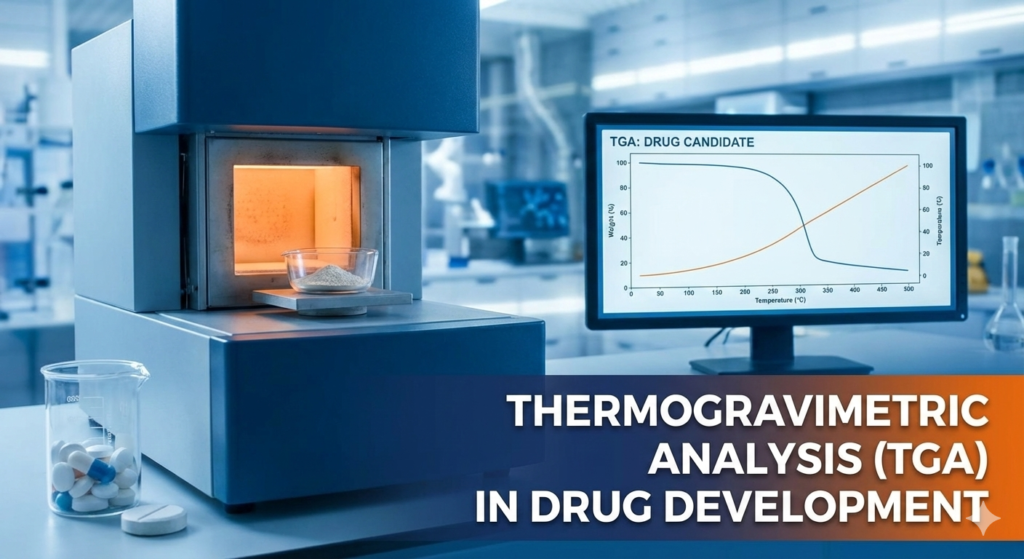
Thermogravimetric Analysis (TGA) is a powerful analytical technique widely used in pharmaceutical research, formulation development, and quality control. It helps scientists understand how a drug substance or excipient behaves when exposed to heat.
This article explains TGA in simple terms, its principle, applications, data interpretation, FAQs, and real-world case studies.
Thermogravimetric Analysis (TGA) is an analytical technique that measures the change in mass of a material as a function of temperature or time under controlled atmospheric conditions.
In pharmaceutical development, TGA is mainly used to:
Related: Pharmaceutical Analysis
In TGA, a small amount of sample (usually a few milligrams) is placed on a highly sensitive microbalance. The sample is heated or cooled at a controlled rate in a furnace while its weight change is continuously recorded.
The resulting data is plotted as:
This plot is known as the TGA curve.
A typical TGA instrument consists of:
Measures minute changes in sample mass with high sensitivity.
Provides controlled heating or cooling with programmable temperature rates.
Usually made of platinum or alumina to avoid interference.
Allows analysis under different atmospheres such as:
Thermogravimetric Analysis is used for multiple pharmaceutical applications, including:
The main output shows mass change with temperature.
Key features include:
A pharmaceutical polymer shows significant weight loss between 250–350°C, indicating degradation of the polymer backbone.
After complete decomposition of organic material, a residual mass remains, confirming the presence of inorganic fillers like silica.
An API exhibits early weight loss below 120°C, confirming moisture content and helping establish drying conditions.
TGA helps assess thermal stability, moisture content, and composition—critical for formulation and storage decisions.
Typically 5–20 mg, depending on material and instrument sensitivity.
Commonly nitrogen (inert), air, or oxygen, depending on study objectives.
TGA provides more detailed thermal information but is often used in addition to, not instead of, LOD tests.
DTG helps identify the exact temperature at which maximum mass loss occurs.
Yes, TGA is a destructive technique since the sample is heated until decomposition.
Pharmaceuticals, polymers, chemicals, materials science, and food industries.
Thermogravimetric Analysis (TGA) is a versatile and essential analytical tool in pharmaceutical development. It provides valuable insights into thermal stability, moisture content, decomposition behaviour, and material composition, supporting better formulation design and quality control.
For further learning, explore related analytical techniques such as:
Further reading:
Quick Links