

Specialty Chemicals vs Commodity Chemicals explained with clear definitions, examples, applications, key differences, market trends, future outlook, and FAQs for industry professionals and students.
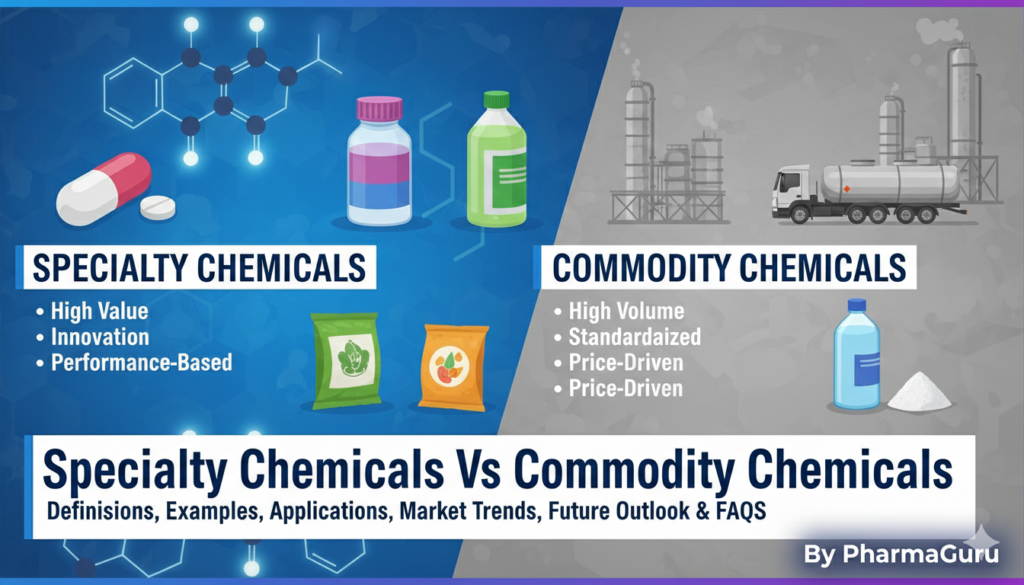
Specialty Chemicals Vs Commodity Chemicals differ significantly in terms of production scale, value, customization, and market focus. Specialty chemicals are low-volume, high-value products designed to meet specific performance requirements—such as electronic-grade solvents or pharmaceutical additives—often involving advanced R&D, customized formulations, and strong technical support. In contrast, commodity chemicals are high-volume, standardized substances like sulfuric acid or ammonia, produced at large scale and sold mainly on price and availability.
The key differences lie in production scale, level of customization, pricing strategy (value-driven vs volume-driven), customer support, and market orientation. While specialty chemicals compete on performance and functionality, commodity chemicals compete on efficiency and cost.
Specialty chemicals play a critical role across industries such as pharmaceuticals, food, cosmetics, agriculture, electronics, and construction. In this article, based on skill-based practical knowledge, you will learn the definitions, key differences, examples, applications, manufacturing aspects, market trends, future outlook, and 11+ frequently asked questions related to specialty and commodity chemicals.
Related: HPLC Method Development
Specialty chemicals are chemicals used as ingredients in finished products or to improve manufacturing processes, designed to perform a specific function.
They are often referred to as:
Unlike bulk or commodity chemicals, specialty chemicals are produced in smaller volumes and formulated to meet specific performance and regulatory requirements. They are essential for manufacturing high-value, high-performance products.
Commodity chemicals are basic, standardised, high-volume chemicals produced on a large scale and sold primarily on cost and availability.
These chemicals act as building blocks for various industries and are generally interchangeable between manufacturers.
Common categories of specialty chemicals include:
Specialty chemicals are used across a wide range of industries:
Their ability to deliver specific performance outcomes makes them indispensable.
The Specialty chemicals market is growing rapidly due to:
The future outlook for specialty chemicals is strong, with continuous opportunities driven by regulatory requirements, customization needs, and technological advancements.
Common analytical instruments used include:
Related:
Leading global specialty chemical manufacturers include:
Many other companies also operate in niche specialty segments worldwide.
| Parameter | Specialty Chemicals | Commodity Chemicals |
|---|---|---|
| Production | Small scale | Large scale |
| Applications | Specific, selective | General |
| Manufacturing | Often non-automated | Highly automated |
| Customization | High | Minimal |
| Market Share | Lower volume | High volume |
| Pricing | Value-based | Cost-based |
Specialty chemical distributors play an important role in the rubber industry by acting as intermediaries between chemical manufacturers and rubber product manufacturers. They provide essential services and products that enable the rubber industry to meet its technical, performance and regulatory requirements. Here are the details of the major roles he played:
Specialty chemical distributors supply a range of chemicals that are critical for rubber manufacturing. These include:
Specialty chemicals and commodity chemicals serve distinct but equally important roles in the chemical industry. While commodity chemicals focus on volume and cost, speciality chemicals emphasise performance, customisation, and innovation.
I hope this article has helped you clearly understand specialty chemicals, commodity chemicals, their differences, applications, and future scope. Feel free to share your questions or learnings in the comments section.
Unlike chemicals, which are manufactured in large quantities, speciality chemicals are produced on a smaller scale and possess unique formulations to deliver specific functions. These chemicals are essential in manufacturing high-value products that meet stringent requirements and performance criteria. Specialty Chemicals have one ore two core applications whereas commodity chemicals have several applications.
Specialty Chemicals are used as ingredients in finish products and to improve manufacturing processes. These chemicals are created to serve a particular function
The top companies in Specialty Chemicals are BASF SE, DOW, Corteva, Sika AG, and Solvay
The Specialty Chemicals segment will play a major role in India’s global growth in the worldwide chemical industries. Next export from the regions are expected to increase to $21 billion by 2040
Examples of commodity chemicals: Sulfuric acid, ammonia, ethylene, chlorine, sodium hydroxide
Difference between fine chemicals and commodity chemicals: Fine chemicals are high-purity, low-volume, specialty chemicals used for specific applications, while commodity chemicals are low-cost, high-volume, standardized chemicals sold mainly on price.
Bulk chemicals are produced in large quantities for general use, whereas specialty chemicals are produced in smaller quantities for specific performance needs.
Crude oil, natural gas, gold, copper, wheat.
Cocoa, Coffee, Cotton, Corn, Copper, Crude oil, Citrus fruits.
Quick Links