Dr. Pramod Kumar Pandey, PhD (Chemistry), is the Founder of PharmaGuru.co and a senior Analytical Research Expert with over 31 years of experience in the pharmaceutical industry. He specializes in analytical method development and validation, pharmaceutical research, quality control, quality assurance, and regulatory compliance, and has contributed to analytical innovation and quality excellence across leading Indian and global pharmaceutical companies.
Contact: admin@pharmaguru.co
HPLC calibration ensures accurate, precise, and reliable results by verifying pump, injector, detector, autosampler, and gradient system performance within acceptance criteria.
HPLC Calibration (High-Performance Liquid Chromatography Calibration) : Key Parameters, Procedure, Frequency, Case Study, and 9+FAQs
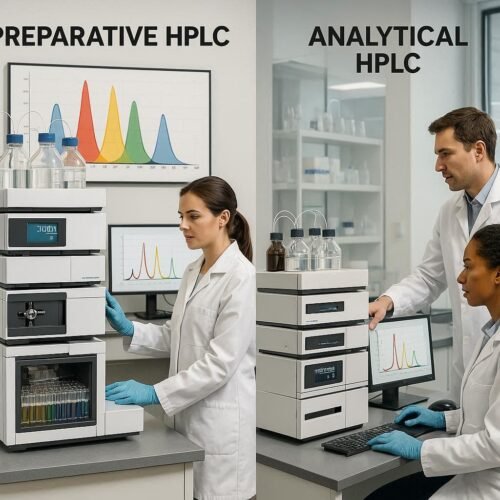
Preparative HPLC (Bing)
HPLC calibration is a critical quality activity that ensures the accuracy, precision, linearity, and reliability of analytical results. Calibration verifies that all critical components—such as pump, injector, detector, autosampler, and gradient system—are functioning within predefined acceptance criteria.
HPLC calibration is mandatory in pharmaceutical, biotech, food, environmental, and contract research laboratories to comply with GMP, GLP, USP <1058>, and ISO guidelines.
% Carryover = (Blank peak area ÷ Test peak area) × 100
Acceptance Criteria: ≤ 0.01%
Carry Over Case Study: Investigation and Resolution of Carryover Failure in HPLC Calibration
Background
A pharmaceutical quality control laboratory performing routine HPLC calibration observed unexpected peaks in blank injections during a carryover test. The instrument was being used for assay analysis of a API, where strict carryover control is critical to ensure result accuracy and patient safety.
According to laboratory SOPs and regulatory guidelines, acceptable carryover must not be more than 0.01% of the test injection response.
Objective
To evaluate the HPLC system carryover, identify the root cause of failure, implement corrective actions, and restore compliance with calibration acceptance criteria.
Method Summary
HPLC Method Chromatographic Conditions
Column: C18 (150 × 4.6 mm, 5 µm)
Mobile Phase: Water: Methanol (60:40)
Flow Rate: 1.0 ml/min
Injection Volume: 20 µl
Wavelength: 254 nm
Run Time: 5 minutes
Carryover Evaluation Procedure
Inject a high-concentration standard solution.
Inject a blank (mobile phase) immediately after.
Calculate carryover using:
% Carryover = (Blank peak area ÷ Test peak area) × 100
After corrective actions, the carryover value was well within the acceptance limit (≤ 0.01%). The HPLC system was declared fit for use, and routine analysis was resumed.
Below is a professionally written, pharma-QC–ready case study focused on HPLC Pump Calibration / Flow Rate Accuracy. It is suitable for GMP documentation, audits, SOP training, blogs, or validation reports.
Pump Calibration Case Study: HPLC Pump Calibration Failure Due to Flow Rate Inaccuracy
Background
A pharmaceutical quality control laboratory performing routine six-monthly HPLC calibration observed inconsistent retention times during system suitability testing for an assay method. Since retention time reproducibility is directly dependent on pump performance, flow rate accuracy calibration was initiated as part of the investigation.
According to the laboratory SOP, acceptable flow rate accuracy is ±2.0% of the set flow rate.
Objective
To evaluate HPLC pump flow rate accuracy, identify the cause of deviation, implement corrective actions, and restore compliance with calibration acceptance criteria.
Calibration Method Summary
Equipment & Materials
HPLC system with a binary pump
HPLC-grade water
Class A volumetric flasks (5 ml, 10 ml)
Calibrated analytical balance
Stopwatch
Set Flow Rates Evaluated
0.5 ml/min
1.0 ml/min
Flow Rate Accuracy Procedure
Mobile phase lines were flushed thoroughly to remove air bubbles.
Pump was allowed to equilibrate for 10 minutes at each flow setting.
Eluent was collected in a Class A volumetric flask.
Time required to collect the specified volume was recorded using a stopwatch.
Collected solvent was weighed and converted to volume using density.
Flow rate was calculated using:
Flow rate = (Collected volume ÷ Time in seconds) × 60
Observed Results
Set Flow Rate: 1.0 ml/min
Parameter
Value
Collected Volume
10.0 ml
Time Taken
640 seconds
Calculated Flow Rate
0.94 ml/min
% Deviation
−6.0%
Acceptance Criteria
Flow rate accuracy: ±2.0%
Deviation
The measured flow rate deviated by 6.0%, exceeding the acceptable limit. The pump failed flow rate accuracy calibration.
Impact Assessment
Retention time shift of approximately 0.4 minutes observed.
Potential impact on assay accuracy and system suitability.
Instrument declared out of calibration, and routine analysis halted.
Root Cause Investigation
The investigation identified the following causes:
Worn pump piston seals
Minor leakage in the pump head
Entrapped air affecting flow stability
Inadequate preventive maintenance interval
Corrective and Preventive Actions (CAPA)
Corrective Actions
Replaced pump piston seals
Performed thorough pump priming
Cleaned and reassembled pump head
Re-calibrated pump flow rate
Preventive Actions
Revised preventive maintenance schedule
Added intermediate flow verification check
Enhanced documentation for pump performance trending
Re-Calibration Results
Set Flow Rate: 1.0 ml/min
Parameter
Value
Collected Volume
10.0 ml
Time Taken
598 seconds
Calculated Flow Rate
1.003 ml/min
% Deviation
+0.3%
Final Outcome
After corrective actions, the HPLC pump flow rate accuracy was found to be within ±2.0% acceptance criteria. The instrument was declared calibrated and fit for use, and routine sample analysis was resumed.
Interview FAQs on HPLC Calibration
What is HPLC calibration, and why is it necessary?
HPLC calibration involves ensuring the performance of an HPLC system and its components (e.g., pump, injector, detector) meets specified standards. This ensures the accuracy, precision, and reliability of analytical results. Regular calibration is essential to verify that the system produces consistent and accurate measurements for reliable data and method validation, particularly in regulated industries like pharmaceuticals
What happens if HPLC calibration fails?
The instrument is deemed out of calibration; analysis must stop, corrective action initiated, and affected data assessed for impact.
Is HPLC calibration mandatory under GMP & GLp?
Yes. Regulatory agencies require documented evidence that HPLC systems are calibrated and fit for intended use.
How often should HPLC calibration be performed?
Calibration frequency depends on several factors, including the complexity of the analysis, system usage, and regulatory requirements. Generally, HPLC systems should be calibrated:
Before using the system for new method development or critical analysis.
Regularly, typically every 6 months for routine monitoring.
After maintenance, repairs, or any part replacement (e.g., pump seals, columns).
After significant changes, such as new column installation or solvent changes.
Always follow specific guidelines outlined by the manufacturer and regulatory bodies (e.g., FDA, ICH).
What are the key parameters to check during HPLC calibration?
Key parameters to check during calibration include:
Flow rate accuracy (Pump calibration).
Injection precision (Injector calibration).
Retention time (to check system stability).
Resolution and peak symmetry (to evaluate column performance).
These parameters ensure optimal performance and reproducibility of results.
How is the linearity of the HPLC detector calibrated?
The linearity of the HPLC detector is typically calibrated by preparing a series of standards with known concentrations of the analyte. The detector response (e.g., absorbance, fluorescence) is plotted against concentration, and a calibration curve is constructed. The curve should show a linear relationship (R² ≥ 0.99). Deviations from linearity can indicate issues with the detector, such as non-linearity at high concentrations or detector saturation.
What is the significance of system suitability tests (SST) in HPLC?
System suitability tests are predefined performance criteria that must be met before starting a series of analyses. These tests include evaluating parameters such as:
Retention time consistency.
Resolution between peaks.
Tailing factor (peak symmetry).
Column efficiency (number of theoretical plates).
SST ensures that the HPLC system is operating within acceptable limits for precise and reliable results, and is particularly important for regulatory compliance.
How do you calibrate the HPLC temperature (oven) control?
HPLC column temperature is critical for consistent retention times and separation. To calibrate the temperature:
Use a calibrated thermocouple or precision thermometer to measure the actual temperature inside the column oven.
Compare the measured temperature with the oven’s setpoint.
Adjust if necessary to ensure ±2°C of the set temperature.
Temperature control should be verified regularly, especially if there is a noticeable shift in retention times or changes in baseline stability.
What should be done if an HPLC system shows high carryover between samples?
Answer: High carryover (residual analyte remaining from a previous sample) can be addressed by:
Regularly cleaning the injector and other parts exposed to sample solutions.
Ensuring wash protocols are set up to adequately clear the system between injections (e.g., longer rinse times, higher solvent volumes).
Checking the injector precision and calibration to ensure accurate volumes are delivered.
Reducing sample concentration in cases where carryover is due to saturation of the injector.