

Learn analytical balance performance verification, including procedures, weighing techniques, error calculation, and uncertainty assessment.
Analytical balance performance verification ensures accurate and reliable weighing by routinely checking accuracy, repeatability, linearity, and drift using certified calibration weights. Daily checks require measured values to remain within ±0.1% of the standard, with the balance properly levelled, draft shield doors closed, and environmental conditions controlled. All results must be documented and reviewed to comply with GMP, GLP, ISO, and USP <41> requirements.
Key verification tests include drift, evaluated by multiple readings of a single weight over time; repeatability, assessed by repeated weighing and standard deviation calculation; and linearity, verified by weighing certified standards across the balance’s operating range. Together, these tests confirm the balance’s suitability for precise and compliant analytical measurements.
This article outlines a standard procedure for verifying the performance of analytical balances, focusing on key metrics such as random error (RE), systematic error (SE), uncertainty, and overall performance. It is designed to help laboratories ensure consistent, compliant weighing results.
The performance verification procedure described here applies to all analytical balances used in QC, analytical development, or related laboratory areas that require high-precision weighing.
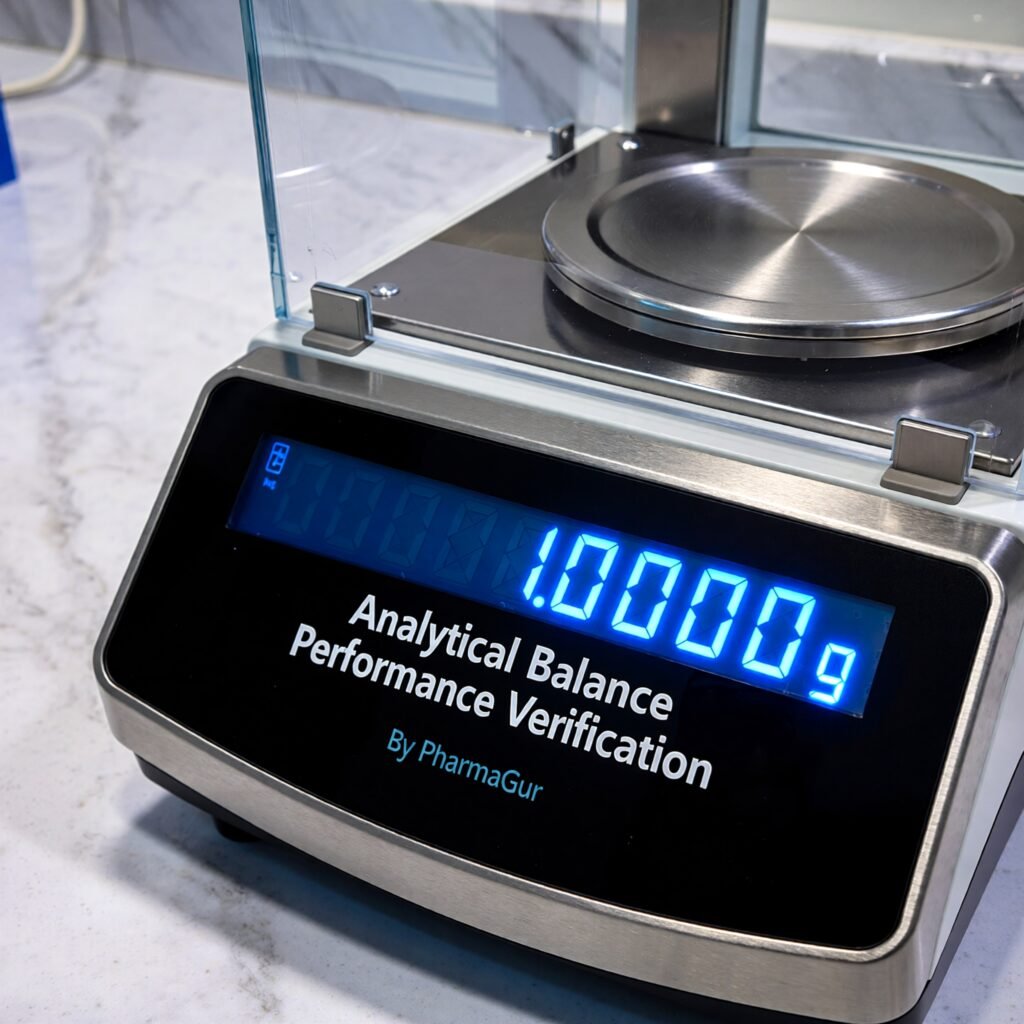
Before beginning official verification:
Note:
| Weight | 0.1mg readability | 0.01mg readability | 0.001mg readability |
|---|---|---|---|
| 5mg | – | – | (0.5%) |
| 10mg | – | (0.5%) | (0.1%) |
| 100mg | (0.5%) | (0.1%) | (0.1%) |
| 1gm | (0.1%) | (0.1%) | (0.1%) |
| 10gm | (0.1%) | (0.1%) | – |
| 100gm | 0.1% | – | – |
The total error percentage is calculated using:
Σ = {(RE+SE) × 100} ÷ WCM
Acceptance criteria for each weight are defined based on the balance type in the procedure tables. (
Uncertainty is assessed by repeated weighings of a certified standard at least six times, with re-zeroing between each measurement. Calculate uncertainty using:
Uncertainty} = (Standard Deviation×3) ÷ Certified Weight Value
Acceptance Criterion:
Recommended weight sets for uncertainty testing:
If any part of the verification fails:
The reference weights used for verification must be calibrated periodically by a certified external laboratory according to their scheduled re-calibration due dates to maintain traceability.
Analytical balance performance verification is essential for ensuring precision, accuracy, and compliance in laboratory weighing activities. Proper verification not only supports regulatory requirements (such as USP <41> and ISO/IEC 17025) but also guarantees reliable results for analytical and quality control processes.
Related:
Analytical balance performance verification is the process of checking accuracy, repeatability, linearity, and drift using certified weights to ensure reliable weighing results. It is important because it ensures compliance with regulatory standards like GMP, GLP, and ISO, and guarantees precise laboratory measurement
Error is calculated using random error (RE) and systematic error (SE). Random error is typically determined as three times the standard deviation of repeated weighings, while systematic error is the difference between the average measured value and the certified weight. The total error percentage is then calculated by combining both values relative to the certified weight
Uncertainty is assessed by performing multiple weighings of a certified standard (usually at least six times), calculating the standard deviation, and expressing it relative to the certified weight. The acceptance criterion generally requires uncertainty to be within a specified limit (e.g., ≤ 0.001) to ensure reliable measurement results
Further reading: 〈41〉 BALANCES
Quick Links