Dr Pramod Kumar Pandey, PhD in Chemistry, is a Analytical expert with 31+ years of experience in pharmaceutical development and the founder of PharmaGuru.co, a global platform for pharmaceutical training and industry insights
What Is GLP (Good Laboratory Practice) and how to implement it effectively—covering key elements, data integrity procedures, real-world case studies, regulatory expectations, and 7+ practical FAQs for laboratories.
What Is GLP (Good Laboratory Practice) And How To Implement It: Key Elements, Data Integrity Procedures, Case Studies & 7+FAQs
GLP (Good Laboratory Practice) ensures that laboratory studies in pharmaceuticals, chemicals, and related industries are conducted with high-quality standards, reliable data, and regulatory compliance. GLP governs every stage of non-clinical studies—from material procurement to analysis, reporting, and documentation.
In this guide, you will learn about GLP, 21CFR Part 58 & Part 11, key elements, quality assurance, SOPs, GDP, STPs, protocols, reports, validation, reference standards, equipment, calibration, and solutions.
What Is GLP (Good Laboratory Practice)?
GLP is a quality control system that ensures the planning, performance, monitoring, recording, and reporting of non-clinical laboratory studies is accurate, reliable, and reproducible. It establishes a safety and quality culture during pharmaceutical and chemical development.
The Aim of GLP (Good Laboratory Practice)
GLP aims to:
Establish a safety culture during pharmaceutical development
Operational Qualification (OQ): Equipment functions as intended
Performance Qualification (PQ): Regular maintenance, tests, and system suitability verification
Role of GLP in Stability Studies
GLP ensures accuracy, reliability, and reproducibility in stability studies. It provides:
Quality control of methods, equipment, and processes
Proper documentation and record-keeping
Standardised procedures for accelerated and long-term stability tests
Regulatory compliance for submissions to FDA, EMA, and ICH
Traceability and accountability for personnel, materials, and equipment
Risk management during stability protocols
21CFR Part 11 and GLP (Good Laboratory Practice)
21CFR Part 11 ensures electronic records and signatures meet data integrity requirements:
Authorised and traceable system access
Electronic audit trails
Secure retention of records
Data security and confidentiality
Secure electronic signatures for both open and closed systems
Record retention:
Submitted results: ≥ 5 years
Non-submitted results: ≥ 2 years
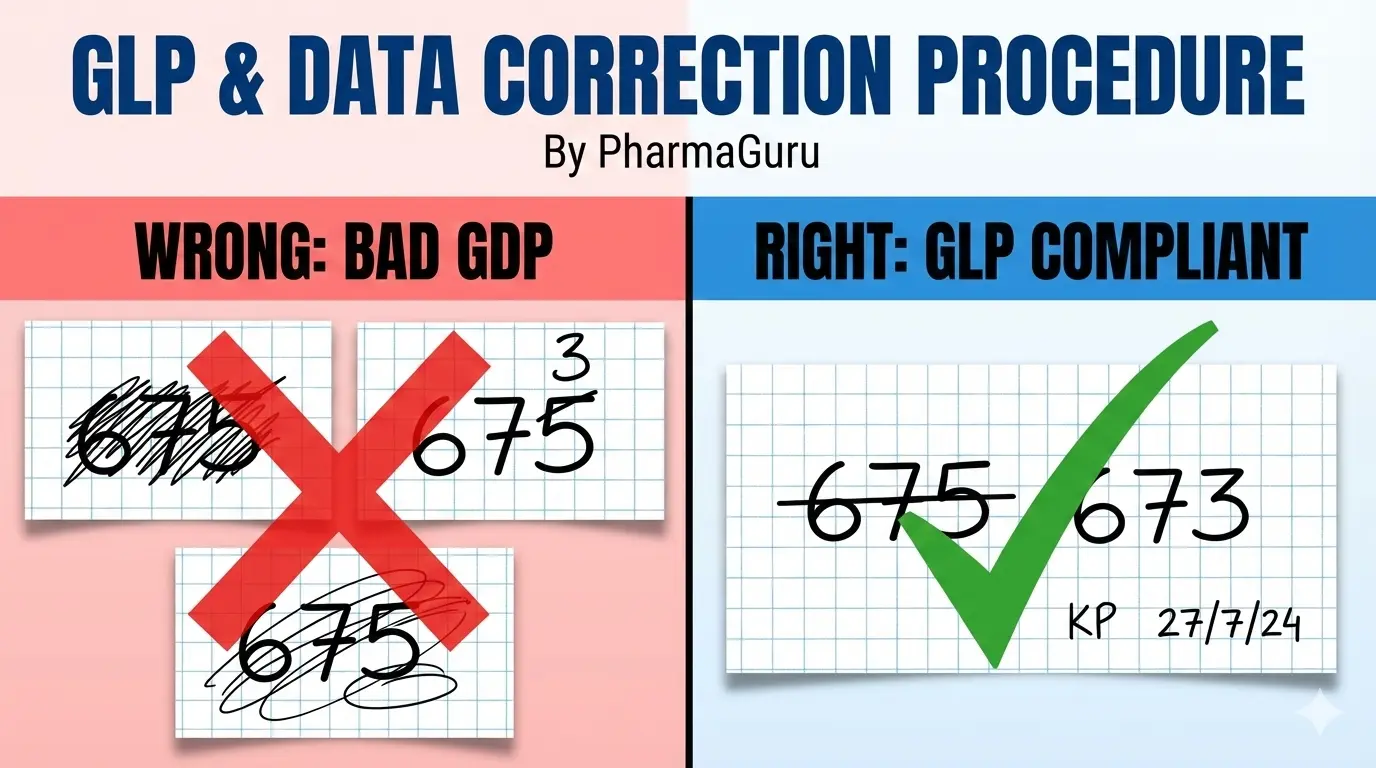
7-Step Data Correction Procedure (GLP-Compliant)
Identify the error (measurement, transcription, missing data)
Document the error with details and cause
Correct the data with a single-line strikethrough (paper) or audit-trail (electronic)
Initial and date the correction
Never overwrite original data
Approval of corrections by supervisor or authorised personnel
Maintain audit trails and original records for review
Case Study: Typo Correction in Laboratory Data
Identify a typo in the lab notebook
Cross out the incorrect entry, write the correct value beside it
Initial and date
Supervisor verifies and signs
Store in the archive with an audit trail
What Is GLP (Good Laboratory Practice) And How To Implement It: Key Elements, Data Integrity Procedures, Case Studies & 7+FAQs 2
Differences Between GLP (Good Laboratory Practice) and GMP
Feature
GMP
GLP
Focus
Manufacturing & quality control
Pharmaceutical/chemical development & analytical research
US Regulation
21 CFR 210 & 211
21 CFR 58
Activities
Manufacturing activities
Non-clinical studies, analytical research, pesticide & chemical testing
Typical Examples of GLP Compliance
Wear PPE during lab experiments
Read MSDS before work
Follow SOPs and STPs
Participate in training & safety exercises
Maintain lab logbooks and clean instruments
Calibrate instruments as scheduled
Conduct internal & external audits
OOS, OOT, CAPA, and GLP
Out of Specification (OOS)
Out of Trend (OOT)
Corrective and Preventive Action (CAPA)
These are generally GMP-driven, but GLP ensures quality and reliability in data generation for CAPA investigations.
Advantages of GLP
Promotes a safety compliance culture
Ensures a safe workplace
Builds confidence in results
Creates an auditable, accountable environment
GLP and Document Archiving
Retention period: ≥ 5 years after final report submission
Data integrity: Protect against unauthorised changes
Accessibility: Quick retrieval for audits
Storage conditions: Controlled environment for physical/electronic records
Responsible personnel: The study director ensures compliance
Electronic records: Must comply with 21 CFR Part 11
Advancements in GLP
Automation and digitalisation improve data integrity and efficiency
Laboratory Information Management Systems (LIMS) and Electronic Lab Notebooks (ELNs) streamline workflows and traceability
Conclusion
Good Laboratory Practice (GLP) is critical for ensuring reliable, reproducible, and auditable data in pharmaceutical and chemical research. By implementing GLP principles, organisations can enhance safety, maintain compliance, improve data integrity, and build a strong culture of quality.
What do you mean by Good Laboratory Practice (GLP)? What is the GLP principle?
GLP (Good Laboratory Practice) is a quality control system covering the organizational process and the conditions under which non-clinical health and environmental studies are planned, performed, monitored, recorded and reported.
What is the code of the GLP?
The “GLP” typically refers to Good Laboratory Practice, which is a set of principles intended to ensure the quality and reliability of laboratory studies, especially in regulated industries like pharmaceuticals, chemicals, and environmental studies. The code for GLP can vary depending on the country or region, but the most recognized standards include: OECD GLP (Organisation for Economic Co-operation and Development): This is an internationally recognised set of guidelines for ensuring the quality and integrity of laboratory studies. The OECD GLP was established in 1997 and is commonly used across many countries. U.S. FDA GLP (Food and Drug Administration): In the U.S., the FDA enforces GLP regulations for non-clinical laboratory studies that support research for FDA-regulated products. The relevant code is found under 21 CFR Part 58. EU GLP (European Union): In the EU, GLP standards are enforced by the European Commission, which adheres to the OECD principles but may have specific guidelines under Directive 2004/10/EC.
What is the role of the QA department as per GLP?
QA personnel are responsible to audit the Laboratory studies
What are the differences between GLP and GMP?
GLP is focused on ensuring that laboratory studies, particularly preclinical studies like animal testing or drug testing, are conducted in a consistent and controlled manner. GLP is applied in analytical and chemical research. GMP ensures that products are produced and controlled according to quality standards during the manufacturing process. This is concerned with production and quality control activities.
What is the full form of CFR?
Code of Federal Regulations
What are the 5 fundamental points of GLP?
The five fundamental points of GLP include: 1.0 Organisation and Personnel: Clear roles and responsibilities for personnel involved in the study must be defined. This includes ensuring staff are appropriately qualified and trained for their roles. 2.0 Facilities and Equipment: Laboratories and testing environments must be adequately designed, maintained, and equipped to ensure the accuracy and reliability of results. Proper calibration, maintenance, and validation of equipment are essential. 3.0 Study Protocols and Reports: A study protocol must be in place, clearly outlining objectives, methodology, and data collection processes. All studies must have well-documented reports that detail the experimental procedures and findings, ensuring transparency. 4.0 Quality Assurance: A quality assurance program must be in place to monitor compliance with GLP standards. This includes periodic inspections and audits to verify the integrity of the studies and ensure the procedures are followed correctly. 5.0 Recordkeeping and Documentation: All activities and results must be thoroughly documented, and records must be stored and maintained for a set period. This includes raw data, final reports, and any modifications made during the study.
What are the advantages of GLP?
GLP helps maintain a safety compliance culture, a better and safer workplace, confidence in results and an auditable workplace
References
A good laboratory practice and current good manufacturing practice, Ludwig Huber, Agilent